
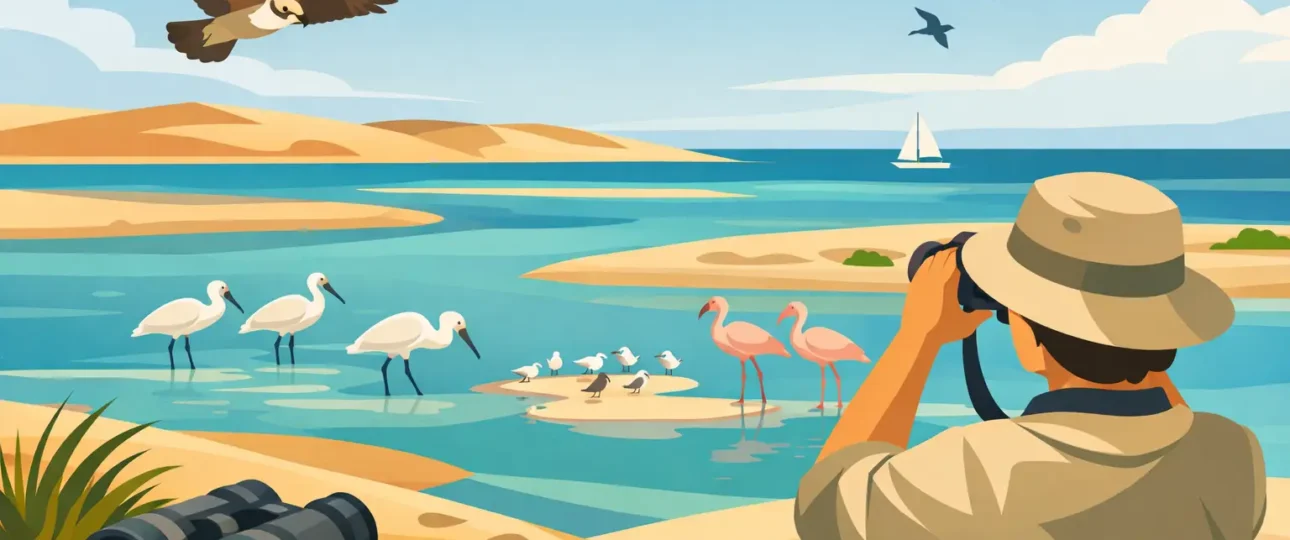
Banc d’Arguin Birding Tour Example Itinerary
The first flock often appears as a moving line above the flats, where pale water, exposed sand, and the Atlantic horizon seem to merge. A well-planned Banc d’Arguin birding tour example itinerary gives you time for those moments instead of rushing between long desert roads and unpredictable tide windows. This is remote coastal Mauritania, and birding here works best when transport, permits, local timing, and comfortable overnight stops are handled carefully.
Banc d’Arguin National Park is not a place for a quick checklist stop. It is a vast wetland and coastal ecosystem where migratory shorebirds gather in extraordinary numbers, alongside resident seabirds and desert-edge species. The reward is scale, quiet, and serious photographic opportunity. The trade-off is that conditions are simple, distances are real, and the best sightings depend on tides, season, weather, and access conditions on the day.
Why a Banc d’Arguin Birding Tour Needs Time
The park lies north of Nouakchott, with the fishing settlement of Iwik often serving as a practical base for exploring coastal areas. Reaching it involves a long overland journey through a landscape that changes from city outskirts to open sand, salt flats, and shoreline. A capable vehicle and an experienced local driver-guide are not luxuries here. They make the route safer and leave you free to watch the landscape rather than manage logistics.
Tides shape the day. At lower tide, broad mudflats and feeding areas can draw dense concentrations of waders. At higher tide, birds may gather in roosting areas that require a different approach and a different viewing position. Your guide should adjust departures around local conditions rather than follow a rigid clock.
For many international birders, the strongest period is generally from late autumn through early spring, when Palearctic migrants are present and daytime temperatures are more comfortable. That said, every month has its own character. Spring can bring changing light and migration activity, while warmer months may appeal to travelers focused on resident species, coastal landscapes, or filming rather than peak migrant numbers.
A 6-Day Banc d’Arguin Birding Tour Example Itinerary
This six-day outline is designed for travelers arriving in Nouakchott who want meaningful time in the park without turning the trip into an exhausting road transfer. It can be shortened for experienced visitors with limited time, but an extra day is usually more valuable than a faster schedule.
Day 1: Arrive in Nouakchott and prepare
Meet your guide at Nouakchott airport and transfer to a clean, secure hotel or guesthouse. Depending on your arrival time, there may be an opportunity for an easy birding walk around coastal lagoons, open scrub, or suitable wetland edges near the capital. This is not the main event, but it helps you settle in, test binoculars and camera equipment, and begin adjusting to the light and climate.
Your guide should review the route, current park access, expected driving time, and the next day’s tide timing. It is also the right time to confirm dietary needs, medication requirements, and luggage arrangements. Soft bags are often easier than rigid cases when vehicles are carrying field gear, water, and overnight supplies.
Day 2: Nouakchott to the Banc d’Arguin coast
After breakfast, depart north toward Banc d’Arguin. The road journey is part of the experience: Mauritania’s coast feels increasingly open and spare as the capital disappears behind you. Stops can be made when conditions are promising, particularly at coastal areas, salt pans, or open desert margins where birds may be active.
Arrive near Iwik or another appropriate park-area base in time to settle into simple but welcoming accommodation. Comfort in this region means clean bedding, good food, drinking water, and a well-organized camp or guesthouse rather than a luxury resort. A late-afternoon outing can provide your first view over tidal flats, with soft light ideal for photography.
Day 3: Tidal flats and shorebird concentrations
This is a full birding day planned around the tide. An early departure may bring you to feeding grounds as mudflats are exposed, where mixed flocks of sandpipers, plovers, godwits, curlews, and other waders can spread across the shoreline. Exact species vary by season and location, so a good guide will focus on reading the conditions rather than promising a fixed list.
Keep the pace unhurried. The park’s appeal is not only the number of birds but the chance to observe behavior: birds feeding in shallow water, raptors moving above open country, and large groups shifting together as the tide advances. A packed lunch, shade plan, and plenty of water allow you to stay in the field when the birding is most productive.
Return before dark for dinner and a relaxed review of the day. If you are a photographer, this is the time to discuss the following morning’s light, focal lengths, and whether a lower-tide or higher-tide location is likely to suit your goals.
Day 4: Roost sites, coastal birds, and local perspective
Start before sunrise for a second tide-focused session. Repeated visits are valuable because bird distribution changes constantly, and familiarity with a site makes it easier to notice new species or behavior. Depending on conditions and permissions, the day may include coastal channels, island-facing viewpoints, or areas used by local Imraguen fishing communities.
Respect for the park and its people matters. Banc d’Arguin is a protected landscape as well as a lived-in coastal environment. Birding should be quiet, patient, and conducted at a distance that does not disturb roosting or feeding birds. A local guide can help ensure vehicles and visitors stay on appropriate routes and that photography is respectful around villages and fishing activity.
The afternoon can be flexible. Serious birders may choose another field session; travelers combining wildlife with culture may prefer time to understand the traditional relationship between fishing communities, the sea, and the park. This flexibility is one reason private or small-group arrangements work particularly well here.
Day 5: Final morning in the park and return south
Use the last morning for a targeted outing based on what you have seen so far. Perhaps there is a species you want to photograph again, a changing tide window worth revisiting, or a coastal location that was too windy on the previous day. Leaving space for this final session is far better than treating the park as a one-visit destination.
After brunch or an early lunch, begin the drive back to Nouakchott. A late arrival is normal after a full day of travel, so pre-arranged accommodation and a reliable transfer matter. A hot shower, secure room, and organized dinner plan can feel especially welcome after several days in the field.
Day 6: Departure or add another Mauritania experience
Transfer to the airport for your international departure, or continue your Mauritania journey. Travelers with more time may add a desert route toward the Adrar region, historic caravan towns such as Chinguetti, or an Iron Ore Train experience. These are very different environments, so allow time to reset expectations, clothing, and equipment.
What We Handle for a Safer, Easier Trip
A Banc d’Arguin journey has moving parts that are easy to underestimate from abroad. Road conditions, park procedures, tide timing, suitable accommodation, meals, water, and vehicle readiness all affect the experience. Tours in Mauritania can organize the in-country details, including transport, permits where required, airport transfers, accommodation, and English-speaking local guidance, with a clear price and no surprise fees.
Bring reliable binoculars, sun protection, light layers for early mornings, closed shoes, a dust cover for camera gear, and a power bank. Long lenses are useful for photography, but patience and a respectful viewing distance matter more than chasing close shots. Expect basic connectivity outside the capital and plan to be comfortably offline.
The best itinerary is not the fastest one. Give Banc d’Arguin enough time for the tide to change, the birds to settle, and the coast to reveal what it has planned for the day.