
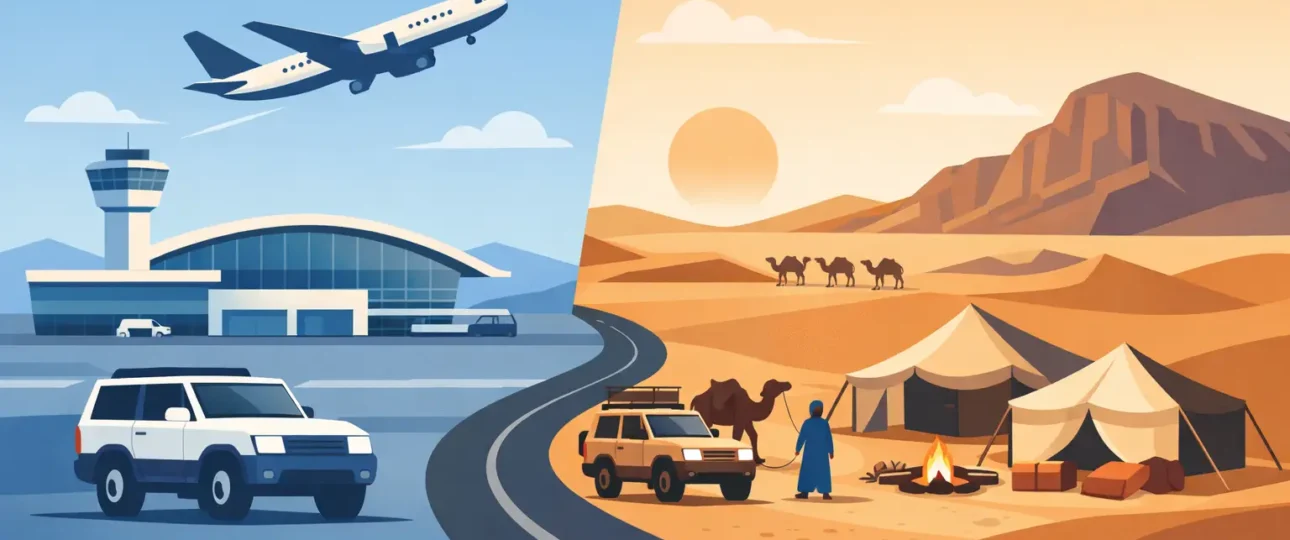
Airport to Desert Camp Logistics in Mauritania
A desert camp can feel wonderfully far from everything, but getting there should never feel uncertain. In Mauritania, airport to desert camp logistics begin the moment your flight lands in Nouakchott: arrival formalities, luggage, a reliable meeting point, road conditions, fuel planning, and the right timing for the drive north or east. When these details are organized locally, you can begin the journey with confidence rather than spend your first hours trying to solve transport questions in an unfamiliar place.
Why Desert Transfers Need Local Planning
Mauritania is built for travelers who want real space, ancient caravan towns, long horizons, and nights beneath clear Sahara skies. It is also a country where distances are meaningful. A desert camp may be reached by paved highway, rough track, sand route, or a combination of all three, depending on the region, the season, and the camp itself.
That is why a transfer is more than a car waiting outside the airport. It requires an itinerary that accounts for your flight schedule, the driving time to your first overnight stop, daylight, road conditions, and the supplies needed once the route leaves larger towns. A well-planned arrival makes the adventure feel exciting. A rushed one can turn a long travel day into an unnecessary test of energy.
For most multi-day Sahara journeys, it is wiser to spend the first night in Nouakchott if your flight arrives late, if immigration takes longer than expected, or if the desert route starts several hours away. This gives you time to rest, meet your guide, confirm the plan, and leave early the following morning. Travelers arriving on an early flight may be able to start the road journey that day, but only when the route, weather, and driver’s assessment make it sensible.
From Nouakchott Airport to the First Night
A dependable airport welcome removes the most common point of uncertainty. Your driver or guide should know your flight details, have a clear meeting arrangement, and remain flexible if baggage delivery or entry procedures take longer than planned. Flights can arrive behind schedule, and local support matters most when plans shift.
After meeting your team, the first practical question is usually whether to stay in Nouakchott or travel onward. This should be decided around safety and comfort, not simply around fitting the maximum number of miles into a day. A clean, secure guesthouse in the capital can be the right start before an early departure toward the Adrar region, Chinguetti, Ouadane, or a desert camp beyond the main roads.
It is also the time to handle small but useful preparations. Your guide can confirm that you have enough drinking water for the road, help with local communication if needed, and make sure important documents are accessible. Keep your passport, visa documents, camera batteries, medications, sunglasses, and a warm layer in your day bag rather than deep inside larger luggage.
Arrival timing changes the best route
There is no one perfect airport-to-camp schedule. An early daytime arrival can create room for a scenic first drive, while an evening arrival normally calls for a night in Nouakchott. Travelers on private or tailor-made itineraries may have more flexibility than those joining a fixed departure, but the same principle applies: avoid beginning a demanding desert drive tired, rushed, or after dark.
The desert is not a place to force a timetable. A professional team will adjust the first day when flight changes, road closures, sand conditions, or weather call for a different plan. That flexibility protects the experience rather than reducing it.
What Happens Once the Road Ends
The transition from airport transfer to desert travel is often gradual. You may begin on paved roads, pass through towns for fuel and supplies, and then continue across tracks that require a high-clearance 4×4 and an experienced local driver. In some areas, the last section to camp is the most beautiful part of the day, with dunes rising beyond the road and the landscape opening in every direction.
This is where vehicle preparation matters. Desert transport should include sufficient fuel, water, a maintained spare tire, recovery equipment, and communication planning appropriate to the route. Your guide should understand the terrain and avoid treating the landscape as a shortcut map. The quickest line across sand is not always the safest or most comfortable one.
Travelers sometimes ask whether they can self-drive from the airport to a camp. For experienced drivers with the correct vehicle, reliable navigation, and knowledge of sand travel, it can be possible on selected routes. But it also shifts every operational responsibility onto the traveler: fuel range, route finding, vehicle recovery, camp coordinates, and what to do if a tire fails far from a town. For most visitors, a guided transfer offers more time to enjoy the changing landscape and less reason to worry about what comes next.
Desert Camp Comfort Is Planned Before You Arrive
A good desert camp is not defined only by its setting. The silence, stars, and dunes matter, but so do practical standards: a welcoming team, clean sleeping arrangements, good meals, drinking water, and a clear plan for evenings when temperatures drop. Depending on the camp and itinerary, you may sleep in a tent, a simple desert shelter, or under the open sky.
Sleeping under the stars is unforgettable, especially on calm, clear nights. It is not always the best choice for every traveler. Wind, cold, privacy needs, and personal comfort can make a tent or sheltered sleeping arrangement the wiser option. A thoughtful operator explains the choices in advance and brings appropriate bedding rather than assuming every guest wants the same experience.
Food logistics also deserve attention. Desert meals are prepared with supplies brought from towns or arranged through the camp. Let your travel team know about allergies, vegetarian needs, medical dietary requirements, or a strong preference well before departure. Remote travel allows less room for last-minute substitutions, though experienced local crews can often accommodate reasonable requests when they have advance notice.
Pack for the transfer, not just the photographs
The Sahara can be hot in direct sun and surprisingly cool after sunset. Light, breathable clothing works well during the day, while a fleece or warm jacket is valuable at camp. Closed shoes protect your feet on rocky ground and in sand, and a scarf can be useful during wind or dust.
Keep electronics protected from fine sand and carry a power bank if photography or filming is central to your trip. Camera crews and filmmakers should discuss equipment cases, charging requirements, drone permissions, and extra vehicle space before arrival. The best shooting conditions often happen early and late in the day, so a crew needs a schedule that respects both light and safe driving.
Permits, Checkpoints, and Route Changes
Some Mauritanian routes, protected areas, and specialized journeys may require permits or advance coordination. Checkpoints can also be part of overland travel. These are normal operational realities, not reasons for concern, provided your documents and route planning are in order.
A local ground team handles these details more efficiently because it knows what information is needed and when it should be prepared. This is particularly valuable for groups, media projects, motorcycle tours, and itineraries that combine remote desert regions with destinations such as Chinguetti, Ouadane, or the Iron Ore Train.
Route changes are another part of responsible desert logistics. Sand can shift, a track can become rougher after weather, or a camp may be better reached by an alternative approach. The goal is not to follow a rigid plan at all costs. It is to protect the quality and safety of the journey while still delivering the experiences that brought you to Mauritania.
Choosing a Partner for Airport to Desert Camp Logistics
When comparing tours, ask what is included between arrival and camp. A clear answer should cover airport pickup, transport type, overnight arrangements before or after the desert, meals and water on remote days, guide support, permits where applicable, and any likely extra costs. Transparent pricing matters because it lets you prepare properly before you travel.
You should also ask who is responsible if a flight is delayed or an itinerary needs to change. The right local partner does not disappear once the airport transfer is complete. They remain reachable, coordinate the next step, and make sensible decisions on the ground. At Tours in Mauritania, this end-to-end planning is designed to let travelers focus on dunes, historic towns, and the people they meet rather than the moving parts behind the journey.
The road from the airport to a desert camp is part of the story, not an obstacle before it. Give it the time, local knowledge, and care it deserves, and your first night beneath the Sahara sky will feel exactly as it should: remote, peaceful, and fully worth the journey.