
Where Mauritania Train Stops on Its Route
The Iron Ore Train is not a scenic railway built around a visitor timetable. It is a working freight line hauling iron ore across the Sahara, and that is exactly why the question of where Mauritania train stops needs a practical answer. Its movements depend on mining operations, loading, track conditions, and rail traffic. For travelers, the key is knowing the major points on the route, choosing the right place to board or leave the train, and having transport ready when the journey ends.
Where Mauritania Train Stops: The Main Route
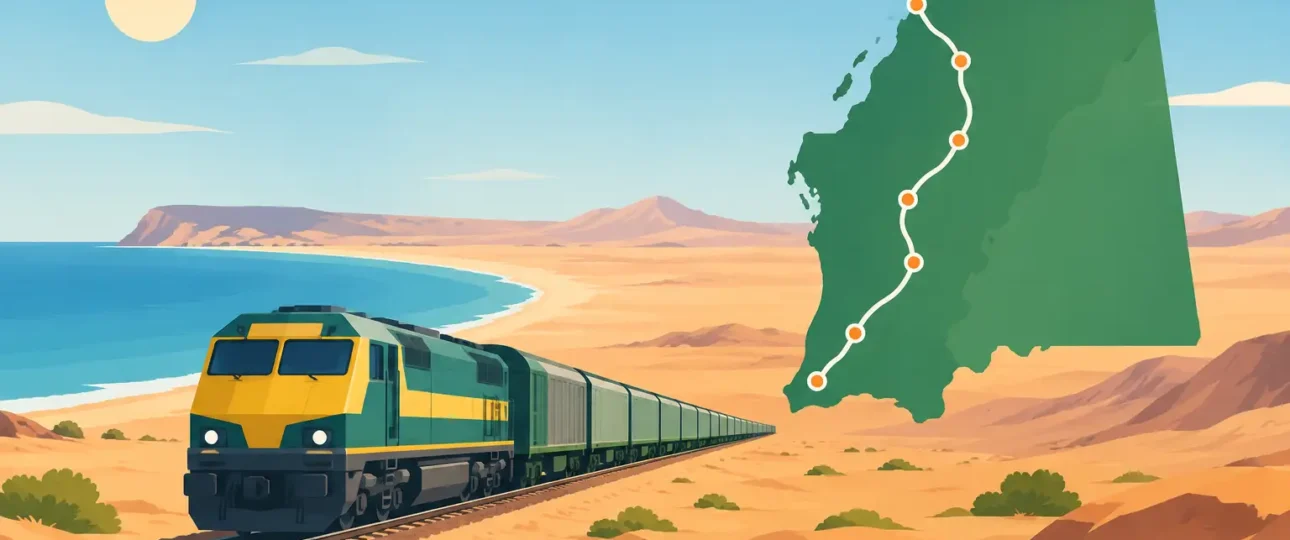
The train runs between the mining region around Zouerat in northern Mauritania and the Atlantic port city of Nouadhibou. The full rail journey crosses roughly 700 kilometers of desert and can take many hours, often overnight. Exact departure and arrival times vary, so this is an experience where flexible planning matters more than a printed schedule.
The three locations most relevant to travelers are Nouadhibou, Choum, and Zouerat. There may be operational pauses at sidings, rail facilities, mines, or points along the line, but these are not reliable passenger stops. A freight train can wait for reasons that are invisible to travelers, then begin moving again without a predictable pattern.
Nouadhibou: The Atlantic-Side Terminus
Nouadhibou is the western end of the route and the most common starting point for travelers joining the train west to east. The city is a major port and industrial center, with rail yards connected to Mauritania’s iron ore exports.
For many itineraries, Nouadhibou is also the most practical place to organize supplies, meet a guide, and confirm local conditions before departure. Travelers may use the passenger carriage when it is operating and available, or experience the open ore wagons, depending on the trip arrangement and the railway’s operations.
The departure point is not an airport-style terminal with fixed boarding gates and clear announcements. It is an active industrial environment. That is one reason experienced local coordination makes a real difference: the practical challenge is not merely finding the rail line, but knowing where to wait, when to move, and what conditions apply that day.
Choum: The Key Desert Stop for Travelers
Choum is the most important stop for visitors who do not plan to travel all the way to Zouerat. Located in the Adrar region, this desert settlement is the usual rail access point for travelers continuing by 4×4 toward Atar, Chinguetti, Ouadane, or other parts of the Sahara.
For many guests, Choum is the natural place to leave the train. A support vehicle can meet the group near the railway, with drinking water, breakfast, and onward transport arranged in advance. After a long night in the open desert, this simple coordination turns a demanding arrival into a manageable transition.
Choum is also a possible boarding point for travelers moving in the opposite direction toward Nouadhibou. However, this should never be treated as a self-service connection. Train timing can shift considerably, and road access from the main Adrar destinations requires careful planning. If you are joining the train here, allow flexibility in your itinerary and avoid scheduling a tight onward flight or fixed commitment the following day.
Zouerat: The Mining-End Terminus
Zouerat is the eastern end of the Iron Ore Train route and the center of Mauritania’s mining industry. It is the point where ore trains are loaded before heading west to the coast. Travelers who ride the full route may arrive here, though it is less commonly used as the endpoint on a classic cultural itinerary than Choum.
The town can be useful for travelers interested in the industrial side of the route or those beginning a northern Mauritania expedition. Yet it is not simply a drop-off point for an independent traveler to figure out afterward. Accommodation, transport, permits where required, and the next stage of the journey should be arranged before arrival.
Some rail operations also serve the wider mining area near Fderik, close to Zouerat. But Fderik should not be assumed to be a regular, accessible stop for train travelers. Operational routing and passenger arrangements can change, so it is best viewed as part of the mining corridor rather than a dependable tourism stop.
Why the Train May Stop Between Stations
A long pause in the desert does not necessarily mean something is wrong. The Iron Ore Train is part of a heavy industrial railway, and freight priorities come first. The train may wait for track clearance, loading operations, passing traffic, crew requirements, or other operational needs.
This is part of the character of the journey. You may wake before sunrise to complete silence, with no visible town, station sign, or clear indication of how long the train will remain still. Then, after a period of waiting, the wagons begin to move again through the desert.
For travelers, the trade-off is straightforward. The journey delivers one of the Sahara’s most memorable experiences: open sky, vast landscapes, and the feeling of crossing a working desert route few visitors ever see. In return, it asks for patience, flexibility, and a willingness to travel without precise timing.
Boarding and Leaving the Train Safely
The right stop depends on the rest of your Mauritania route. Travelers arriving in Nouadhibou and heading toward the historic caravan towns usually board in Nouadhibou and leave in Choum. Those traveling from the Adrar region toward the coast may board around Choum and continue to Nouadhibou. A full journey to Zouerat is better suited to travelers with additional time and a confirmed plan for onward transport.
Conditions can be physically demanding, especially in an open ore wagon. Wind carries fine iron dust. Temperatures can fall sharply at night and rise quickly after sunrise. There is no ordinary onboard service, no guaranteed restroom access, and no certainty that you will board or arrive at a conventional station.
A well-prepared journey needs warm layers, eye protection, a scarf or face covering, gloves, sufficient water, simple food, a flashlight, and a secure way to protect cameras and phones from dust. Choose clothing you do not mind getting dirty. More importantly, make sure your pickup vehicle and driver are confirmed before you step onto the train.
Travelers should also understand that access arrangements can vary. Sometimes a passenger carriage may be attached; at other times, the experience is centered on the ore wagons. Availability is operational, not guaranteed. A responsible itinerary does not promise a specific train configuration before local conditions are confirmed.
Plan the Train Journey Around Your Route, Not a Clock
The best Iron Ore Train itineraries build in buffer time. Avoid booking it on the night before an international departure, a domestic connection, or a fixed hotel check-in that cannot move. Plan for a flexible arrival, especially when leaving the train in Choum or continuing onward to the Adrar region.
For photographers and filmmakers, the route is extraordinary, but the same rule applies. Protect equipment from dust, carry backup power, and allow for changing light and unplanned stops. The strongest images often come from those unscripted pauses: blue-hour desert silence, low sun across the ore, and the scale of the train cutting through an empty horizon.
At Tours in Mauritania, we organize the practical pieces around this iconic journey, including ground transport, desert logistics, secure places to rest before and after the ride, and support when local operations change. You can focus on the experience while a local team handles the coordination that makes it possible.
The Iron Ore Train rewards travelers who leave room for the unexpected. Know whether Nouadhibou, Choum, or Zouerat fits your route, keep your schedule flexible, and let the Sahara set the pace for one unforgettable night on the rails.