6 Best Mauritania Motorcycle Routes to Ride
The best Mauritania motorcycle routes are not measured only by miles or difficulty. They are defined by what happens between them: a paved road disappearing into the Adrar, tea shared beneath an acacia tree, ancient stone towns rising from the sand, and a night in a quiet desert camp under a full sky. This is a country for riders who want a genuine Sahara journey, but it rewards preparation, local knowledge, and a sensible pace.
Mauritania is not a place to treat like a quick self-guided road trip. Fuel stops can be far apart, road and sand conditions change, and desert tracks rarely come with signs. With an experienced local team handling route planning, accommodation, permits where required, mechanical contingencies, and support transport, the riding becomes what it should be: demanding, memorable, and free from avoidable stress.
Best Mauritania motorcycle routes for an authentic ride
1. Nouakchott to Atar via Akjoujt
For many riders, the road north from Nouakchott is the natural start to a Mauritanian motorcycle expedition. Leaving the capital, the landscape gradually opens into a broad mineral-colored horizon. The route through Akjoujt toward Atar combines long paved stretches with the feeling of entering the Sahara properly.
This is not the most technical route, but it is one of the most useful. It links the airport and coastal capital with the Adrar region, where Mauritania’s most compelling riding begins. It is also a good day to settle into the heat, wind, traffic habits, and long-distance rhythm of the country before moving onto more remote tracks.
The trade-off is that this is a transit day as much as a scenic one. Riders who want only dunes may find the highway sections repetitive. Yet it is the dependable backbone of a well-organized itinerary, especially when a support vehicle carries extra water, luggage, tools, and fuel reserves.
2. Atar to Chinguetti
The ride from Atar to Chinguetti is short enough to enjoy without rushing and dramatic enough to feel like a major crossing. Low mountains, open plains, and sand encroaching on the road create a strong introduction to the Adrar. As Chinguetti approaches, the scenery becomes more intimate and historic.
Chinguetti is one of Mauritania’s great caravan towns. Its old quarter, built from stone and mud brick, stands at the edge of the desert like a surviving memory of trans-Saharan trade. For culture-focused riders, this route earns its place because the destination is as important as the road.
A comfortable overnight here changes the experience. Rather than arriving late and leaving at dawn, stay long enough for a guided walk through the old town, a slow dinner, and the deep silence that settles after dark. Clean, welcoming accommodation matters after a dusty riding day, particularly for travelers combining adventure with photography or filming.
3. Chinguetti to Ouadane by desert piste
This is the route that turns a motorcycle trip into a true desert expedition. Between Chinguetti and Ouadane, the direct line is not simply a road. It is a changing network of tracks across gravel plains, soft sand, shallow dunes, and open desert. Conditions depend on wind, recent use, and the exact route selected.
The reward is immense. There are long stretches where the landscape feels untouched, with no utility poles, no buildings, and no sense of hurry. Ouadane appears gradually from the desert, an extraordinary fortified settlement whose ruins and narrow lanes hold centuries of caravan history.
This is best suited to confident off-road riders on appropriate dual-sport or adventure motorcycles. Sand skills are helpful, but judgment matters more than speed. A guide who knows the current piste, a reliable support vehicle, satellite communication, recovery equipment, and a clear regrouping plan are not luxuries here. They are part of riding responsibly.
If your group includes newer off-road riders, the route can be adapted. Some travelers ride selected sand sections while the support team helps with difficult passages, or they choose a less technical desert approach. The right itinerary should fit the group, not force every rider into the same challenge.
4. Atar, Terjit, and the Adrar escarpment
For a route with more variety and less commitment to deep sand, ride the terrain around Atar and Terjit. The Adrar escarpment brings rocky rises, dry valleys, palms, and small settlements into a compact area. It feels very different from the empty dune fields farther east.
Terjit is particularly welcome after the dry heat of the road. Its oasis setting, shaded by palms and fed by springs, offers a natural pause before returning to desert terrain. This route works well early in an itinerary, when riders are building confidence, or near the end, when they want scenery without another hard sand day.
It is also a strong option for mixed groups. Experienced riders can enjoy the changing surface and mountain views, while travelers more focused on culture, landscapes, and photography still have plenty to see. A locally planned route can include short detours that are easy to miss without someone who knows the area.
5. Choum, Ben Amira, and the Iron Ore Train country
The area around Choum offers one of Mauritania’s most cinematic motorcycle landscapes. The terrain is stark, rocky, and enormous, with the monolith of Ben Amira rising from the desert. It is a region where the scale of the Sahara becomes physical: dark stone, pale sand, and sky in every direction.
This route pairs naturally with the story of the Iron Ore Train, one of the country’s signature adventure experiences. Riding to the railway country and experiencing the train are different activities, each with its own timing and logistics. A good itinerary coordinates transport, accommodation, and safe meeting points rather than assuming everything can be improvised on arrival.
Riders should expect rougher surfaces, isolation, and strong winds in this part of the country. The route is best for travelers who value remote landscapes over fast progress. It is not about covering a huge distance. It is about having time to stop, look around, and understand how far from ordinary travel you have come.
6. Nouakchott to Banc d’Arguin’s coastal edge
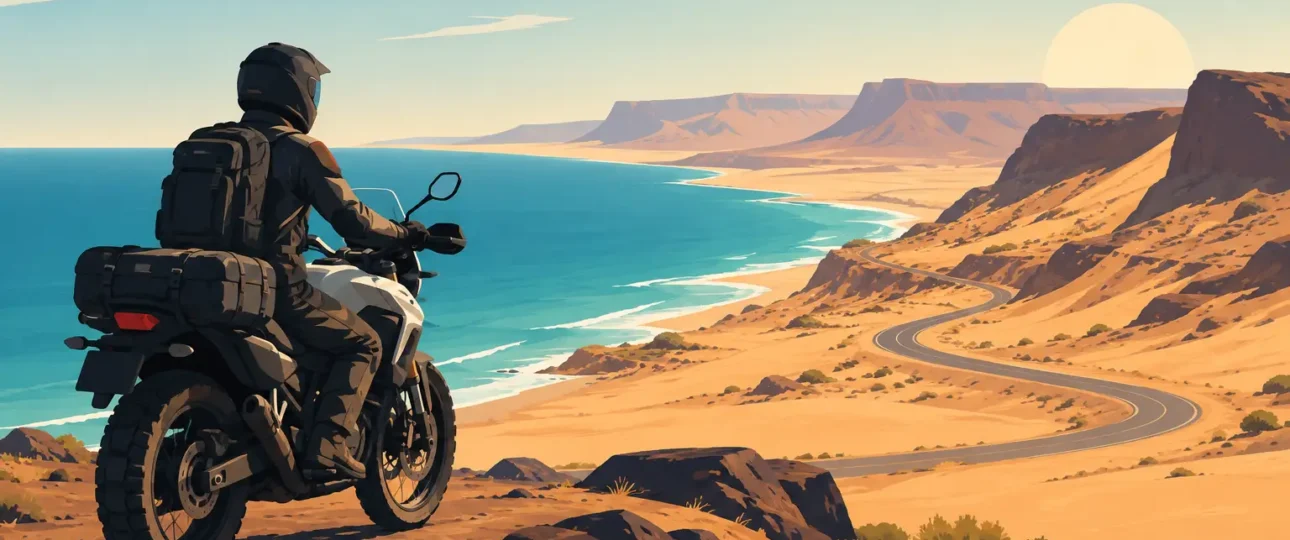
Mauritania’s Atlantic coast provides a striking contrast to the inland Sahara. North of Nouakchott, the landscape becomes flatter and brighter, with salt air, shorebirds, fishing communities, and desert meeting the ocean. The approach to Banc d’Arguin can be an excellent addition for riders who want to see more than dunes and caravan towns.
This is not a route for racing across protected landscapes. Parts of the wider area are environmentally sensitive, and access may involve local rules, permits, and route restrictions. It is essential to follow guidance, stay on approved tracks, and avoid disturbing wildlife or coastal communities.
For photographers, this route can be especially rewarding in the softer light of morning and late afternoon. For riders, it offers a calmer kind of adventure. The surfaces may still be sandy and conditions can change, but the atmosphere is completely different from the inland desert.
What makes a motorcycle route in Mauritania workable
The motorcycle matters, but planning matters more. A lightweight dual-sport bike is often easier to manage in soft sand than a heavily loaded large adventure motorcycle. On the other hand, riders covering longer paved transfers may prefer the comfort and range of a larger machine. There is no single correct choice, provided the bike is prepared for heat, dust, rough ground, and remote riding.
Fuel strategy deserves serious attention. Stations are available on main corridors, but desert riding requires extra range and disciplined refueling. Carry more water than you expect to need, protect electronics from dust, and use luggage that can tolerate vibration and occasional drops in sand. Good gloves, eye protection, breathable layers, and a warm layer for cool desert nights all earn their place.
The strongest expeditions also build in flexibility. A sandstorm, mechanical issue, or difficult section can alter the day’s plan. That is normal in Mauritania. The goal is not to follow a schedule at all costs; it is to travel safely while keeping the journey enjoyable. Guided support gives riders that flexibility without leaving them to solve every problem alone.
Ride with the desert, not against it
Mauritania rewards riders who arrive curious, prepared, and willing to slow down. Start with a route that matches your real off-road experience, allow time for Chinguetti and Ouadane rather than treating them as checkpoints, and keep the deep desert sections supported. With the right local planning, the road ahead can be as reassuring as it is wild – and every stop can feel like part of the journey rather than a logistical problem.