
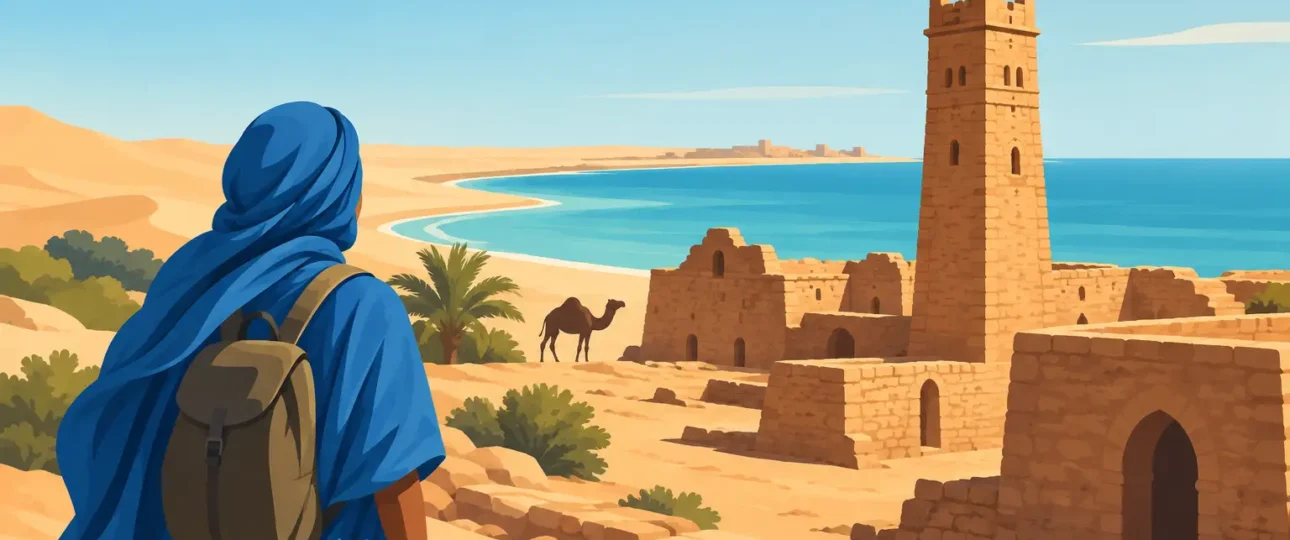
Mauritania UNESCO Sites Travel Guide for 2026
The pages of an ancient manuscript in Chinguetti, the wind-carved lanes of Ouadane, and the bird-filled shallows of Banc d’Arguin belong to very different Mauritanias. A well-planned Mauritania UNESCO sites travel guide brings them together without treating the journey as a checklist. These are remote places shaped by desert, sea, and long distances, where reliable vehicles, local knowledge, comfortable overnight stops, and realistic timing make the experience far more rewarding.
Two UNESCO landscapes, two very different journeys
Mauritania has two UNESCO World Heritage inscriptions. The Ancient Ksour of Ouadane, Chinguetti, Tichitt and Oualata preserve four historic settlement centers that once served trans-Saharan trade, scholarship, and Islamic culture. Banc d’Arguin National Park protects a vast coastal ecosystem where desert meets the Atlantic and migratory birds gather in extraordinary numbers.
Most first-time visitors focus on Chinguetti and Ouadane in the Adrar region. This is the most practical historic route from Nouakchott, and it combines old caravan towns with dune crossings, oases, rock formations, and desert camps. Chinguetti is known for its ancient libraries and stone-built quarters, while Ouadane rises above a broad desert plain, its ruined streets revealing the scale of a former trading center.
Tichitt and Oualata are equally significant, but reaching them requires more time and a dedicated eastern itinerary. They should not be added casually to a short Adrar trip. Road conditions, distances, fuel planning, and overnight arrangements all need careful coordination. For travelers with a week or less, Chinguetti and Ouadane offer the strongest introduction to the ksour.
Banc d’Arguin is a separate experience altogether. Located on the Atlantic coast between Nouakchott and Nouadhibou, the park is defined by shallow waters, islands, fishing communities, and open horizons rather than desert architecture. It is particularly compelling for birders, photographers, filmmakers, and travelers who want to understand Mauritania beyond the Sahara.
Mauritania UNESCO sites travel guide: choose the right route
The best itinerary depends less on how many sites you can fit in and more on the kind of experience you want. Combining Chinguetti, Ouadane, and Banc d’Arguin is possible, but it works best with enough days to absorb the travel distances. Rushing from one landmark to another can mean arriving in beautiful places at the least useful hours, then leaving before the light, silence, and local stories have had time to settle in.
For a focused cultural and desert journey, allow at least five to seven days. Start in Nouakchott, travel north toward Atar and the Adrar, then continue by 4×4 to Chinguetti and Ouadane. This route can include desert camping, an oasis stop, and time to walk through the old quarters with a guide who can provide context beyond the architecture.
For a broader trip that includes the coast, plan roughly eight to 10 days. A logical flow is Nouakchott, Banc d’Arguin, Nouadhibou, then the Adrar region, or the reverse. The exact order can change according to flight schedules, weather, park arrangements, and whether you are adding the Iron Ore Train journey. A local operator can adjust the route without leaving you to solve transport changes in the middle of the desert.
Travelers specifically interested in Tichitt or Oualata should consider a longer expedition. These towns reward serious cultural interest, but access is more demanding than the standard Adrar circuit. This is where fixed departure expeditions or privately guided travel are especially valuable: vehicles, fuel, permits, secure accommodations, and communication all need to be arranged before departure.
What makes Chinguetti and Ouadane worth the journey
Chinguetti is often described as the spiritual heart of Mauritania. Its historic mosque, narrow lanes, and private manuscript collections reflect centuries when scholars and caravans crossed this part of the Sahara. The old town is not a museum behind ropes. It is a living, fragile place where sand movement and erosion are part of the reality.
A respectful visit is unhurried. Walk with a knowledgeable local guide, ask before photographing people or manuscripts, and understand that access to libraries may depend on the custodian and the day. The experience is strongest when you come prepared to listen rather than expecting a conventional monument visit.
Ouadane has a different feel. Its elevated position, stone ruins, and expansive views make it especially rewarding near sunrise or late afternoon. The old settlement tells a story of salt, gold, trade routes, and shifting desert conditions. It also pairs naturally with nearby geological landscapes and desert tracks, making it a highlight for photographers and travelers who want both culture and adventure in the same day.
Desert nights between these towns are part of the journey, not merely accommodation. A well-run camp should provide clean bedding, a practical meal setup, safe drinking water, and a team that understands the terrain. Sleeping under the stars can be wonderfully simple without being poorly organized.
Visiting Banc d’Arguin with care
Banc d’Arguin National Park demands a slower rhythm. The park is internationally important for migratory birds, including waders, flamingos, terns, and other species that use its rich coastal habitat. Winter and spring are often the most appealing periods for birdlife, although conditions and sightings vary with the season.
Access and activities should be coordinated in advance with the relevant local authorities and park arrangements. Depending on your route, this may involve 4×4 travel over sand, a boat excursion, or time with Imraguen fishing communities. Conditions can change quickly with tides, wind, and track conditions, so flexibility is sensible.
The park is not the place for loud, high-speed sightseeing. Keep distance from birds, avoid disturbing fishing activity, and follow guidance on where vehicles and boats may go. Bring sun protection, a wind layer for the coast, binoculars if you have them, and camera equipment protected from sand and salt air.
When to go and what to pack
For most travelers, the cooler months from October through April are the most comfortable for the Adrar and desert camps. Days can still be warm, while evenings and early mornings may be surprisingly cold. December through February calls for layers, particularly if you are sleeping outdoors or traveling in an open vehicle.
Summer travel is possible, but heat changes the nature of the trip. Long drives, walks through old towns, and desert activities need to be planned around the strongest sun. It can suit experienced travelers with flexible schedules, but it is not the easiest time for a first visit.
Pack light but deliberately: breathable clothing that covers shoulders and legs, a warm layer, sturdy closed shoes, sunglasses, sunscreen, a headlamp, personal medication, and a reusable water bottle. A scarf or buff is useful in wind and sand. For photography, bring more battery capacity than you expect, since charging opportunities can be limited on remote routes.
The logistics that matter most
Mauritania rewards independent-minded travelers, but it is not a destination where logistics should be improvised. Distances are substantial, road and sand-track conditions vary, and services outside major towns can be limited. A 4×4 is essential for many Adrar and Banc d’Arguin routes, and a skilled driver is as important as the vehicle itself.
Before setting out, confirm your visa requirements, airport transfer, route plan, accommodation standard, meals, park access, and any local permissions needed for your itinerary. Ask who is available if a vehicle issue, weather change, or schedule adjustment occurs. Clear answers are a sign of responsible trip planning.
Tours in Mauritania can handle transport, bookings, desert camps, permits, and in-country support as part of a guided itinerary. That means you can focus on the ancient towns, the dunes, and the coast while a local team manages the moving parts behind the scenes. Clear pricing and dependable overnight arrangements matter even more when the next guesthouse or fuel stop may be many hours away.
Travel with patience and respect
The UNESCO sites of Mauritania are powerful partly because they have not been polished into easy attractions. Sand may cover a lane you expected to walk. A library visit may depend on a family’s availability. A coastal boat outing may shift with weather or tides. These are not failures of the journey. They are reminders that the desert and the Atlantic set the pace.
Give the route enough time, travel with guides who know the terrain and communities, and leave room for the unexpected stop: tea in a small town, a quiet sunset above Ouadane, or a flock lifting from the shallows at Banc d’Arguin. That is where Mauritania’s heritage becomes more than a place on a map.