Mauritania Train Versus Road Travel: Which Fits?
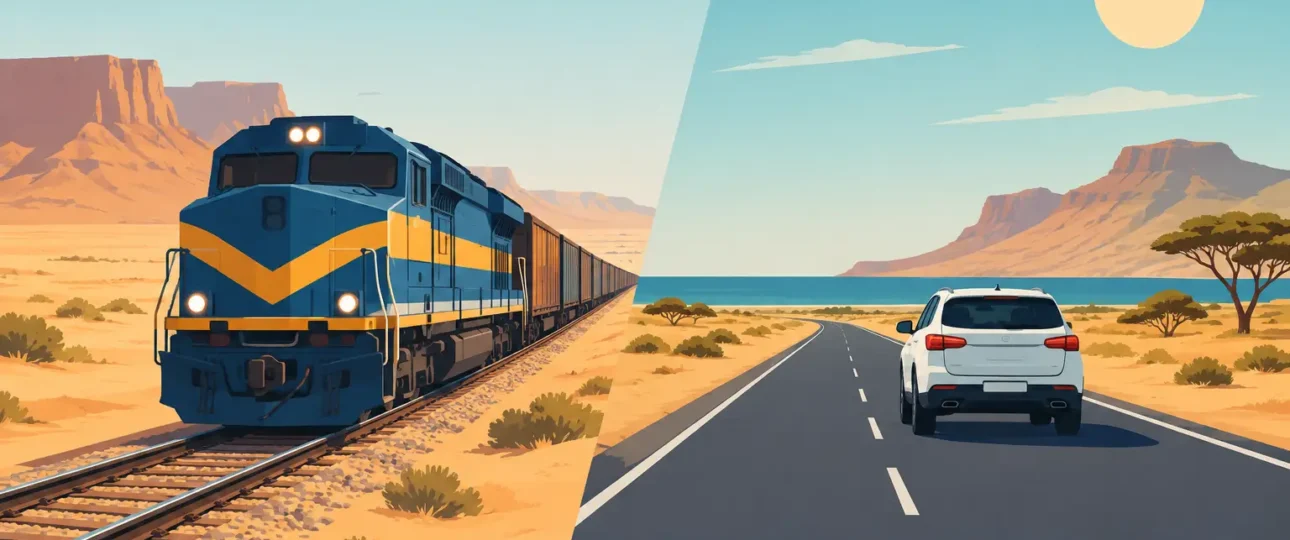
The Iron Ore Train is not simply a way to get from one place to another. It is an exposed, physical journey across the Sahara, where iron dust, wind, changing temperatures, and long waiting periods are part of the story. That is why Mauritania train versus road travel is not a simple question of speed or price. It is a choice between two very different ways of experiencing the country.
For some travelers, riding the train in an open ore wagon is the defining adventure of a lifetime. For others, a well-supported road journey offers deeper access to Mauritania’s historic towns, dunes, coast, and communities with far greater comfort and control. Both can be exceptional when planned realistically.
Mauritania Train Versus Road Travel at a Glance
The Iron Ore Train runs between the mining town of Zouerat and the Atlantic port of Nouadhibou, carrying freight as its first purpose and passengers as a secondary consideration. Schedules can shift, boarding arrangements can change, and the trip can last far longer than expected. It is a raw, memorable experience rather than a conventional rail service.
Road travel is more flexible. A private 4×4 and experienced local driver can follow the pace of your itinerary, stop for photographs, reach desert camps, and connect destinations that the railway never touches. You can travel from Nouakchott to the Adrar plateau, explore Chinguetti and Ouadane, cross dune fields, and continue to Banc d’Arguin or the coast with luggage, water, shade, and support close at hand.
The best choice depends on what you want the journey itself to demand from you.
Choose the Train for the Story, Not the Convenience
An Iron Ore Train journey suits travelers who want to earn the experience. You may ride in an open wagon loaded with iron ore, often overnight, with no reserved seat, no onboard restroom, and no reliable departure time. The train can be loud, cold after sunset, hot during the day, and covered in fine black dust from end to end.
That difficulty is also its appeal. You are traveling through an enormous desert landscape in a way that feels far removed from ordinary tourism. At night, the sky can be extraordinary. At dawn, the line of wagons and the dark ore against pale sand create images that photographers and filmmakers rarely forget.
However, the train is not the right choice for every adventure traveler. It is demanding on the body, hard on camera equipment, and unsuitable for anyone who needs predictable timing, easy access to facilities, or a clean sleeping environment. Travelers with respiratory concerns, mobility limitations, or a low tolerance for cold and dust should think carefully before committing.
What the train experience really requires
The key is preparation and local coordination. Bring clothing that can get permanently stained, a dust mask or scarf, eye protection, warm layers for the night, enough water, substantial food, wet wipes, and a headlamp. Protect cameras and phones in sealed bags, and keep power banks accessible.
Just as important, allow extra time in your itinerary. Freight operations set the train’s schedule, not visitors’ plans. A train journey should never be placed immediately before an international flight or a fixed onward connection. A good local team monitors conditions, manages transfers to the boarding area, and builds contingency time into the route so a delay does not become a crisis.
Choose Road Travel for Range, Comfort, and Flexibility
Road travel is the better fit when you want to see more of Mauritania without treating every transfer as an endurance challenge. The country’s most compelling places are spread across vast distances, and a 4×4 journey turns the travel days into part of the experience rather than an obstacle between highlights.
On the road, you can pause beside camel herds, photograph shifting dunes in the best light, visit a small desert settlement, or change the day’s route when weather and conditions call for it. You can also carry the practical comforts that matter in a remote destination: drinking water, a first-aid kit, spare fuel, shade, luggage, and camping equipment.
Road travel also makes it possible to combine landscapes and cultural sites in one structured trip. The ancient libraries and stone streets of Chinguetti, the dramatic setting of Ouadane, the oasis of Terjit, the vast Adrar plateau, and the coastal life around Nouadhibou each require a different route. A train alone cannot connect them.
Comfort does not mean a lesser adventure
A guided road expedition can still include long desert drives, nights in a camp beneath the stars, and routes far beyond paved highways. The difference is that the challenge is managed. Your driver knows when sand conditions require a different approach, your guide can organize local permissions and overnight arrangements, and you arrive with enough energy to enjoy the place you came to see.
For first-time visitors to Mauritania, this balance is often decisive. Remote travel feels more rewarding when someone has already handled the details: reliable transport, secure guesthouses, desert camp setup, route planning, and communication if plans need to change.
Timing, Safety, and the Reality of Remote Travel
Neither option should be judged by the standards of a city break. Mauritania rewards patience, and conditions can change with heat, wind, roadworks, sand, and local logistics.
The train carries the greater physical exposure. There is limited shelter, no meaningful control over timing, and an environment that can be difficult if you are not properly equipped. Its risks are manageable for prepared travelers, but it should be approached honestly and with knowledgeable support.
Road travel gives more control, but it also depends on experienced logistics. Desert routes are not places to improvise with an unfamiliar rental vehicle or an overloaded schedule. Distances are long, fuel planning matters, and mobile coverage can be limited outside larger towns. A capable local driver and guide add real value here, not just convenience.
For both journeys, travel insurance, sun protection, hydration, and sensible packing are essential. It also helps to keep expectations flexible. The most memorable moments in Mauritania often happen because a plan leaves room for the country’s own rhythm.
Photography: Dust and Drama or Access and Variety?
Photographers often feel pulled toward the Iron Ore Train, and understandably so. The scale is cinematic: endless wagons, dark mineral textures, windblown clothing, desert horizons, and powerful portraits of a working railway. If this visual language is central to your project, the train can be worth the discomfort.
But road travel usually delivers more variety over several days. You can work at sunrise and sunset, return to a scene if light improves, carry tripods and protected equipment more easily, and photograph architecture, markets, oases, dunes, and village life. For a filming team or a traveler with delicate gear, this control can outweigh the train’s single dramatic setting.
The strongest itinerary may combine both. Travel by road through the Adrar and the desert, then include the Iron Ore Train as a carefully prepared signature experience. This gives you the story of the railway without asking it to carry the whole journey.
When a Combined Journey Makes Sense
A combined itinerary is ideal for travelers with enough time and a real appetite for contrast. Start with road-based exploration so you can settle into the country, enjoy comfortable overnight stops, and understand the desert landscape before taking on the train. Then treat the railway as one intense chapter rather than the entire trip.
This approach also protects the rest of your plans. If the train departs late or arrives later than expected, a flexible ground team can adjust transfers and accommodation. Tours in Mauritania can coordinate the transport, permits, train logistics, desert camps, and secure stays around the experience, with a clear plan before you arrive.
The Better Choice Is the One You Will Enjoy
Choose the Iron Ore Train if you want a story you can feel in your bones, accept uncertainty, and are prepared for dust, cold, and a very basic overnight journey. Choose the road if you value comfort, cultural depth, flexible stops, and the ability to see Mauritania beyond one rail corridor.
There is no need to prove yourself by choosing the harder option. Mauritania is already vast, remote, and unforgettable. The right route is the one that lets you meet it with curiosity, proper preparation, and enough support to enjoy every mile.