Guided Tour vs Self Drive for Mauritania
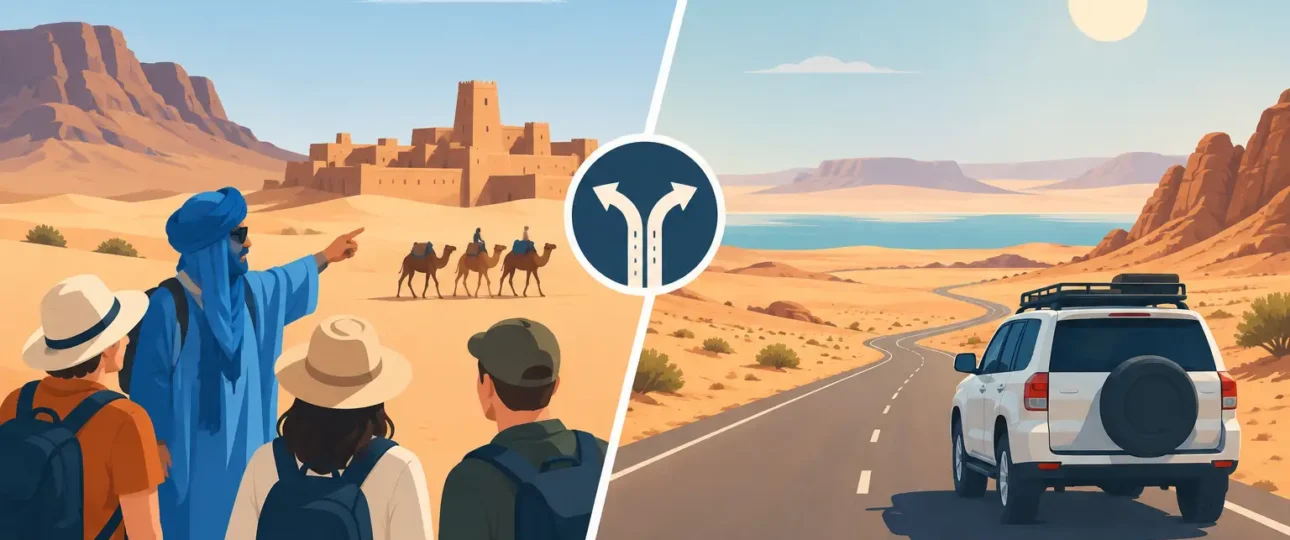
The guided tour vs self drive decision changes the kind of Mauritania you experience. A well-planned road trip can take you from the Atlantic coast to ancient caravan towns and vast Sahara dunes. But this is not a destination where a rental car, an offline map, and a loose itinerary always equal freedom. Distances are long, services are limited outside major towns, and the most memorable routes often require local knowledge as much as a capable vehicle.
For some travelers, driving independently is the right fit. For many others, especially first-time visitors, a guided trip offers more time for Chinguetti’s old libraries, a quiet night beneath desert stars, and the extraordinary Iron Ore Train journey – with far less time spent managing logistics. The best choice depends on your experience, priorities, and the places you hope to reach.
Guided tour vs self drive: the essential difference
A guided tour replaces operational uncertainty with a structured, locally supported journey. Your route, transport, accommodations, meals where included, desert camp arrangements, airport transfers, and necessary coordination are organized in advance. A knowledgeable guide also helps you understand what you are seeing, from the trading history of Ouadane to the changing landscapes of the Adrar.
Self drive puts those decisions in your hands. You choose when to stop, how long to stay, and whether to change course. That flexibility can be rewarding if you have strong overland experience, enough time to absorb delays, and confidence traveling in remote environments. It also means you are responsible for route research, fuel planning, vehicle recovery, accommodation availability, communication, and any changes that arise along the way.
Neither option is automatically better. The more remote your itinerary becomes, however, the more valuable reliable local support becomes.
When a guided trip is the better choice
Mauritania is a place of big distances and small margins. A guided trip is especially suitable when you want to travel beyond the main paved corridors without making every day an exercise in logistics.
You want to reach the desert, not just look at it
The Adrar is one of Mauritania’s great rewards: golden dune fields, rocky plateaus, palm-lined oases, and historic towns that once welcomed trans-Saharan caravans. Yet desert travel requires practical judgment. Tracks can shift after wind, routes may not appear accurately on standard maps, and a vehicle problem far from a town is more than an inconvenience.
With an experienced local driver and guide, you can cross dunes with purpose, stop at viewpoints worth the detour, and camp in places selected for both atmosphere and practical comfort. You are not trying to identify a safe route as the light fades or wondering whether the next fuel stop is open.
You value context as much as access
Chinguetti and Ouadane are not simply scenic stops. Their architecture, manuscript libraries, caravan history, and position in Saharan life become far more meaningful when someone can explain the details. The same is true in Nouakchott, along the coast, and in villages that independent visitors may pass through quickly.
A good guide also acts as a cultural bridge. They can help with language, local etiquette, photography permissions, and conversations that would be difficult to arrange alone. For photographers and filmmakers, this coordination can be the difference between arriving at a location and actually being ready to work there.
You want the Iron Ore Train experience handled properly
Riding Mauritania’s Iron Ore Train is an unforgettable adventure, but it is not a standard rail excursion with fixed tourist infrastructure. Timings can change, conditions are rugged, and the process requires realistic expectations and careful coordination.
A guided itinerary helps you prepare for the dust, cold night air, basic conditions, transfers, and onward travel. Rather than treating the train as a box to check, you can experience it with the right equipment, support, and a clear plan for what comes next.
Your travel time is limited
Independent travel takes time before the journey begins and during it. You may need to confirm accommodations, find reliable route information, arrange a 4×4, stock supplies, and solve unexpected issues. That can be part of the appeal for seasoned overlanders with several weeks to spare.
If you have one or two weeks and want to see Mauritania deeply, a guided tour is usually more efficient. The days are built around realistic driving times, secure overnight stops, and experiences that fit the route. You spend less time chasing confirmations and more time watching the desert change color at sunset.
What self drive does well
Self drive can be a meaningful choice for travelers who prefer a slower, self-directed rhythm. It works best on a carefully defined route, particularly if you plan to remain close to established roads and towns, have a dependable 4×4 where needed, and understand the limits of your vehicle and navigation tools.
It can also suit repeat visitors. Someone who has already explored the classic Adrar circuit with a guide may return to spend extra days in a favorite town, work on a personal photography project, or follow a narrower interest at their own pace.
The freedom is real. You can take an unplanned morning in Nouadhibou, linger over tea in a roadside town, or change your overnight stop if conditions allow. But that freedom is most enjoyable when supported by preparation, local contacts, and a willingness to adapt when plans change.
The practical realities independent drivers should consider
Before choosing self drive, be candid about the trip you are planning. A paved route between cities is one thing. A dune crossing, remote desert camp, national park visit, or multi-day off-road section is another.
Fuel strategy matters. Stations are not evenly spaced, and availability cannot be assumed in every remote area. Carrying enough water, knowing where you can resupply, and having a way to communicate if your plans change are fundamental, not optional. In desert terrain, a second vehicle or an experienced local driver is often the safer choice.
Navigation needs a backup plan. Downloaded maps are helpful, but they do not replace knowledge of road conditions, seasonal changes, military or administrative controls, and the tracks that locals actually use. Ask current questions locally rather than relying only on a route report from a previous season.
Accommodation is another consideration. Outside larger centers, standards and availability vary. Travelers who want clean, welcoming, secure guesthouses or a well-organized desert camp may prefer having those stays confirmed before arrival. During a guided journey, the practical details are arranged so that a long driving day does not end with a search for somewhere suitable to sleep.
Finally, consider paperwork and access. Requirements can differ by activity and location, particularly for specialized travel, protected areas, media work, or remote excursions. A local operator can help clarify what is needed and coordinate the right arrangements before you set out.
Cost: compare the full trip, not the vehicle rate
At first glance, self drive may appear less expensive because you see the daily car rental price. The true cost can be harder to predict. Add fuel, additional insurance, recovery equipment, local assistance, accommodation, food, permits or access arrangements where relevant, and the cost of itinerary changes. A problem with a vehicle in a remote area can quickly affect both your budget and your schedule.
A guided tour has a clearer upfront cost because the major components are bundled. For travelers who value transparent planning, this is often a benefit rather than a restriction. You know who is responsible for transport, bookings, and support before landing in Nouakchott.
Tours in Mauritania builds guided journeys around this principle: clear pricing, carefully selected stays, and active in-country coordination. That does not mean every traveler needs a full itinerary. It means travelers can choose support at the level their route genuinely requires.
A middle path for independent-minded travelers
The choice does not have to be completely guided or completely alone. Some travelers use private transport and a local guide for remote sections, then spend independent time in Nouakchott or another town. Others arrange a driver for the Adrar and keep a few open days before or after the main expedition.
This approach preserves personal flexibility while adding expertise where it matters most. It can be particularly sensible for small groups, motorcycle travelers, and photographers who need a route tailored to their pace but do not want to manage every local arrangement from afar.
Choose the trip that lets you be present
If your dream is to test your overland skills on a patient, carefully prepared journey, self drive can offer a strong sense of ownership. Build in extra days, prepare thoroughly, and keep your route realistic.
If your dream is to stand in an ancient Saharan town, cross dunes safely, sleep under a wide field of stars, and board the Iron Ore Train without carrying the full weight of the logistics, choose guided support. Mauritania rewards travelers who arrive ready to be curious – and who give themselves the space to notice where they are.