Do Guided Tours Include Permits in Mauritania?
A desert route can look simple on a map: leave Nouakchott, cross the Adrar, sleep beneath the stars, and reach a caravan town by sunset. On the ground, it involves route planning, local coordination, and sometimes official permissions. So, do guided tours include permits? Often, yes – but the useful answer is to understand exactly which permits are covered, which traveler documents remain your responsibility, and what happens when plans change.
For a guided trip in Mauritania, permits and access arrangements are part of the practical work that turns a remote itinerary into a well-managed experience. A dependable local operator should explain this clearly before you travel, not leave you guessing at a checkpoint or after you have booked.
Do Guided Tours Include Permits? It Depends on the Tour
There is no single permit that applies to every journey in Mauritania. Requirements can vary by destination, activity, nationality, vehicle type, group size, and the purpose of your visit. A cultural journey through Chinguetti and Ouadane may have different administrative needs than a media production, a motorcycle expedition, or an itinerary involving protected natural areas.
On a properly organized guided tour, the operator will usually arrange the permissions and local authorizations needed for the planned route and activities. This may include access coordination for specific regions, local registrations, vehicle paperwork, or permissions required for a scheduled excursion. When these costs are included in the tour price, they should be presented as part of the itinerary rather than appearing later as an unexpected charge.
That does not automatically mean every travel document is included. Your passport, visa eligibility, travel insurance, and any personal documentation required for entry are separate matters. Some operators can assist with visa processing or provide guidance, but travelers should never assume that a tour booking replaces the need to meet Mauritania’s entry requirements.
Three Things Travelers Often Call “Permits”
The word permit can cause confusion because it is used for several very different things. Clarifying the category makes it easier to know what your tour operator can manage.
Entry visas and personal travel documents
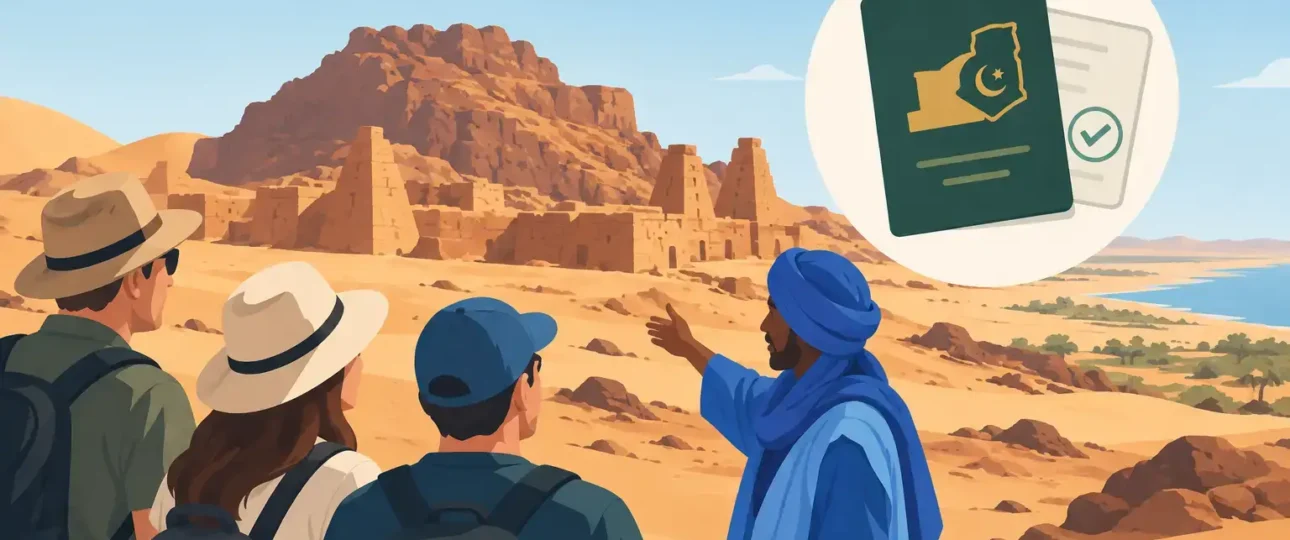
A visa allows you to enter a country. It is connected to you as a traveler, your passport, and your nationality. A tour company may support your application, provide confirmation documents, or offer a visa service where available, but the traveler remains responsible for having a valid passport and meeting entry rules.
Before departure, check your passport validity, visa process, and whether your nationality has any additional requirements. Rules can change, so information that was correct for a previous traveler may not apply to your trip months later.
Route, access, and local operating permissions
These are the arrangements most commonly handled as part of a guided itinerary. Remote travel in Mauritania is not simply about choosing a road. Desert tracks shift, local conditions change, and some places require advance coordination. Your guide and ground team use current local knowledge to select appropriate routes, prepare transport, and handle the practical permissions tied to the program.
This is particularly valuable on multi-day journeys through the Sahara, the Adrar region, or destinations where services are limited. It means you can focus on the dunes, ancient libraries, tea with local hosts, and the quiet of a desert camp instead of trying to resolve logistics in an unfamiliar language.
Special permissions for filming, research, or commercial work
Photographers traveling for personal enjoyment generally have different needs from a crew producing commercial content, a documentary, or a brand campaign. Filming with professional equipment, drones, large crews, interviews, or commercial intent may require additional approvals. These permissions can take time and may involve separate fees.
If your trip includes a media project, share the details early: locations, crew size, equipment list, intended use, and planned schedule. A specialist ground partner can then assess what needs to be arranged instead of making assumptions after arrival. The same principle applies to research projects, events, and expeditions with unusual equipment or vehicles.
What Should Be Included in the Tour Price?
A clear tour quote should tell you whether route-related permits and local access fees are included. The most reassuring wording is specific: permits for the stated itinerary, transport, guide services, planned accommodation, and listed activities are included, while visas, insurance, personal purchases, and optional extras are separate.
Be cautious with a low headline price that says little about what it covers. In a destination with long distances and remote terrain, the missing details matter. A package may exclude permits, park or site fees, airport transfers, fuel supplements, camping equipment, or changes required by weather and road conditions. Cheap can become expensive when the operational essentials are added later.
Tours in Mauritania builds permit coordination, transport planning, airport support, and on-the-ground assistance into its structured trips wherever these services apply to the confirmed itinerary. The goal is straightforward: a clear price, no surprise fees, and a team in the country that can respond if conditions require a practical adjustment.
Questions Worth Asking Before You Book
You do not need to become an expert in Mauritanian administration before choosing a tour. You do need a written understanding of what is covered. Ask whether all permits and access fees for the published itinerary are included in the quoted price. Then ask whether any special arrangements apply to your nationality, planned activities, camera equipment, drone, or independent travel before or after the tour.
It is also sensible to ask what happens if a route cannot be used. Strong operators do not promise that every desert track will remain exactly as planned. They explain how they make decisions around safety, weather, local advice, and access restrictions. A route change should protect the quality of your experience, not create confusion over unexpected costs.
For travelers joining an Iron Ore Train experience, confirm the current arrangements in advance as well. This is an extraordinary journey, but it is not a standard rail excursion with a fixed tourist framework. Timing, access, comfort expectations, and local conditions require careful planning. The right operator will be candid about the adventure and prepared for the practical side.
Why Permit Planning Matters in Remote Mauritania
Permits are not exciting in the way that sandstone cliffs, camel tracks, and centuries-old caravan towns are exciting. Yet they are one reason those experiences can feel calm rather than complicated. Good preparation helps your guide keep the group moving, communicate with local contacts, and adapt responsibly when needed.
It also supports a more respectful way to travel. Mauritania’s desert landscapes, villages, cultural sites, and protected environments are not backdrops to be used without consideration. Following local rules, using appropriate routes, and arranging access properly helps protect the places that make the journey meaningful.
The best guided travel does not make you feel processed through a rigid schedule. It gives you room to experience Mauritania while the essential details are being handled by people who know the terrain. Before you book, ask for a clear inclusion list, share any unusual travel plans early, and choose a team that treats permits as part of responsible hospitality – not as a last-minute problem for you to solve.