How to Photograph Mauritania Iron Ore Train
The iron ore train does not arrive on a studio schedule. It rumbles through the Sahara on a working railway, carrying dark mineral cargo across an immense, shifting landscape. To photograph Mauritania iron ore train well, you need more than a camera and a dramatic idea. You need patience, practical planning, respect for the railway, and local support that puts safety before the shot.
For photographers and filmmakers, this journey can produce frames that feel almost unreal: a freight train disappearing into heat haze, iron ore dust lifting in low sun, a quiet station under a field of stars. The strongest images come from treating the experience as an expedition rather than a quick photo stop.
Plan the Journey Before You Pack a Camera
The train runs between the mining town of Zouerat and the Atlantic coast near Nouadhibou, but exact timing and access can change. It is an industrial operation, not a tourist attraction. Delays are normal, departures are not always predictable, and conditions at stations can be basic.
This is where organized local logistics make a real difference. A knowledgeable guide can coordinate transport to the appropriate rail point, assess conditions on the ground, help manage supplies, and explain the current practical requirements. Tours in Mauritania can arrange the wider journey so your airport transfers, desert transport, accommodation, and train experience fit into one clear itinerary rather than becoming separate problems to solve in a remote region.
Allow time on both sides of the train ride. Arriving late and trying to force the experience into a narrow schedule usually leads to rushed decisions and missed light. A flexible itinerary gives you room for a delayed departure, a desert camp, and a recovery night after the journey.
What Makes This Train So Photogenic
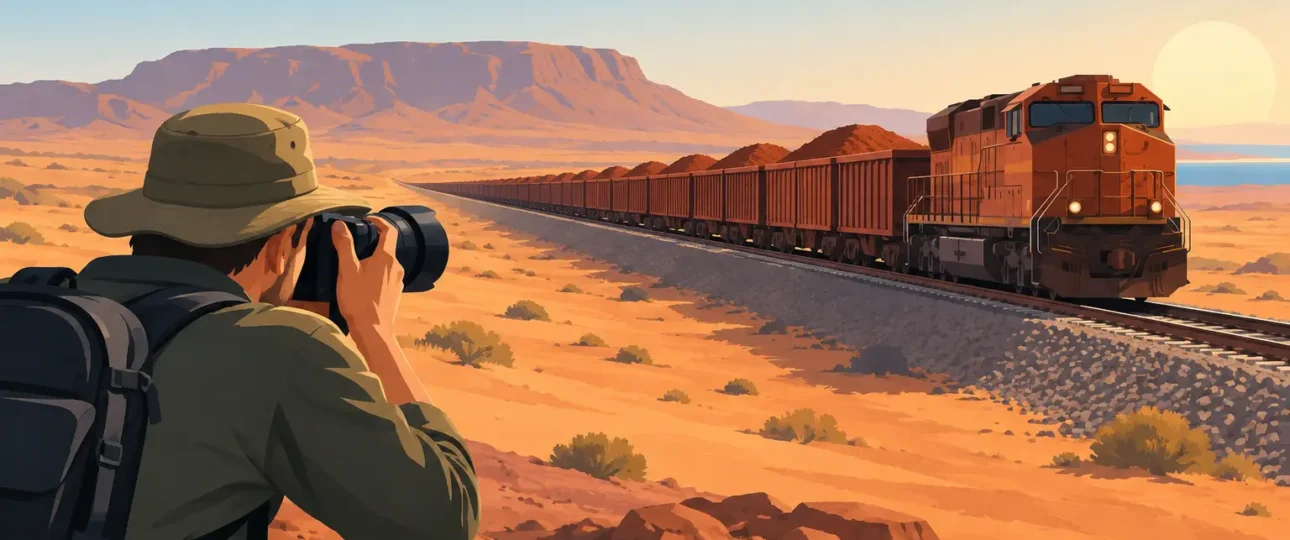
The appeal is not simply its size, although the train is one of the world’s longest and heaviest freight trains. It is the contrast. Hard industrial geometry crosses a landscape defined by open sand, rock plateaus, pale sky, and silence.
Look for the visual relationships rather than photographing only the locomotive. A small human figure near the wagons communicates scale. Repeating ore cars create powerful leading lines. A distant ridge, a weathered station sign, or the tracks bending through sand can give your image a sense of place.
The train also changes character throughout the day. Midday can feel harsh, with high contrast and little shelter, but it can work well for graphic black-and-white images. Early morning and late afternoon are more forgiving for portraits and broad desert scenes. Blue hour is especially useful around stations, when artificial lights and deepening sky add atmosphere without needing to be on the moving train.
Photograph the Waiting, Not Just the Ride
Some of the most memorable photographs happen before departure or after arrival. Hands preparing water, boots covered in dust, a guide checking supplies, travelers watching the rails, and the long pause before the wagons begin to move all tell the fuller story.
These quieter frames also offer a practical advantage: you can work deliberately, communicate with people, and avoid changing lenses in difficult conditions. They turn a collection of dramatic landscape images into a visual narrative.
Camera Gear That Earns Its Place
Travel light, but protect what you bring. Fine iron ore dust is the central technical challenge. It can work its way into lens mounts, buttons, zippers, and sensor areas. A professional camera body is helpful, but careful packing matters more than expensive equipment.
A two-lens setup is usually enough. A wide-angle lens captures the train’s scale, the wagon interiors, and the vast horizon. A short telephoto, such as a 70-200mm equivalent, lets you isolate patterns, distant figures, and compressed landscapes without carrying excessive weight. A fast normal lens can be valuable after dark or for portraits in low light.
Use a protective camera cover or a simple cloth barrier when dust rises. Keep the camera in a sealed bag when you are not actively shooting, and carry a few clean microfiber cloths in separate bags. Avoid changing lenses while the train is moving or while wind is blowing dust across the wagons. If you have two camera bodies, the reduced lens swapping can be worth the extra weight.
Bring more battery capacity than you expect. Cold desert nights can reduce battery performance, and charging opportunities may be limited. A compact power bank, spare memory cards, a headlamp with a red-light mode, and a dustproof pouch for cards are all sensible additions. A tripod can be useful for station scenes and stars, but it is rarely practical aboard a moving freight train.
Settings for Dust, Motion, and Big Desert Light
There is no single correct exposure for this journey. It depends on whether you want to show movement, stop a portrait, or preserve the glow of evening dust.
For sharp images of people or details on a moving train, begin around 1/500 second and raise the shutter speed if movement is more pronounced. For intentional motion blur, slow down carefully and brace yourself, but do not compromise your balance for an experiment. Continuous autofocus and burst mode can help when the landscape shifts quickly, although slower, considered compositions often tell a better story.
In bright sun, watch your highlights. Pale sand and sky can look clean to the eye while clipping in the file. Slightly underexposing by a small amount can preserve highlight detail, especially when shooting raw. Check your histogram when conditions allow, not only the image preview.
Dust can confuse autofocus and reduce contrast. Focus on a strong edge, use a single focus point when necessary, and review critical frames at full magnification during calmer stops. Do not chase perfection in every file. A little haze and grit are part of the visual truth of the route.
Safety Comes Before the Frame
This is a demanding rail and desert environment. Keep well clear of tracks, locomotives, couplings, and railway operations. Follow guidance from your local team and railway personnel at all times. Do not climb equipment, stand in unsafe positions, or ask anyone to recreate a moment near moving wagons for a photograph.
If traveling in an open ore wagon is permitted and forms part of your arranged experience, secure your gear and keep it low. Sit or position yourself as instructed. The train’s movement, wind, vibration, and dust can be stronger than expected, particularly after dark. Wear closed shoes, protective layers, eye protection, and a scarf or face covering suited to the dust.
Water is not optional. Carry more than you think you will need, along with high-energy food and any personal medication. The desert can feel mild at sunset and become cold later, so pack a warm layer even if the afternoon is hot. Your guide should know your group’s needs and have a clear plan for transport, communication, and onward accommodation.
Photograph People With Respect
Mauritania offers extraordinary human stories, from railway workers and drivers to families in towns along the route. But a compelling portrait begins with consent, not with a long lens from a distance. Ask through your guide when language is a barrier, show interest before raising your camera, and accept a no without discussion.
When someone agrees, keep the portrait simple. Use the train, desert, or station environment to provide context, but let the person remain the center of the image. Showing a photograph on your screen can create a genuine exchange and often leads to a more relaxed second frame.
For commercial filming, larger production equipment, or planned shoots involving crews, advance coordination is particularly important. Requirements may vary, and a ground partner can help ensure the work is respectful, organized, and appropriate to local conditions.
Give Yourself Permission to Put the Camera Down
The pressure to document every moment can make photographers miss the journey itself. There will be times when dust is too heavy, light is flat, or the safest choice is to pack the camera away. Those are not failed moments.
Listen to the train, watch the desert change color, and take in the scale without a viewfinder between you and the horizon. When the light returns and the conditions are right, you will be ready to make photographs that carry the feeling of Mauritania home with you.