
Ouadane Ancient Ruins Guided Tour Experience
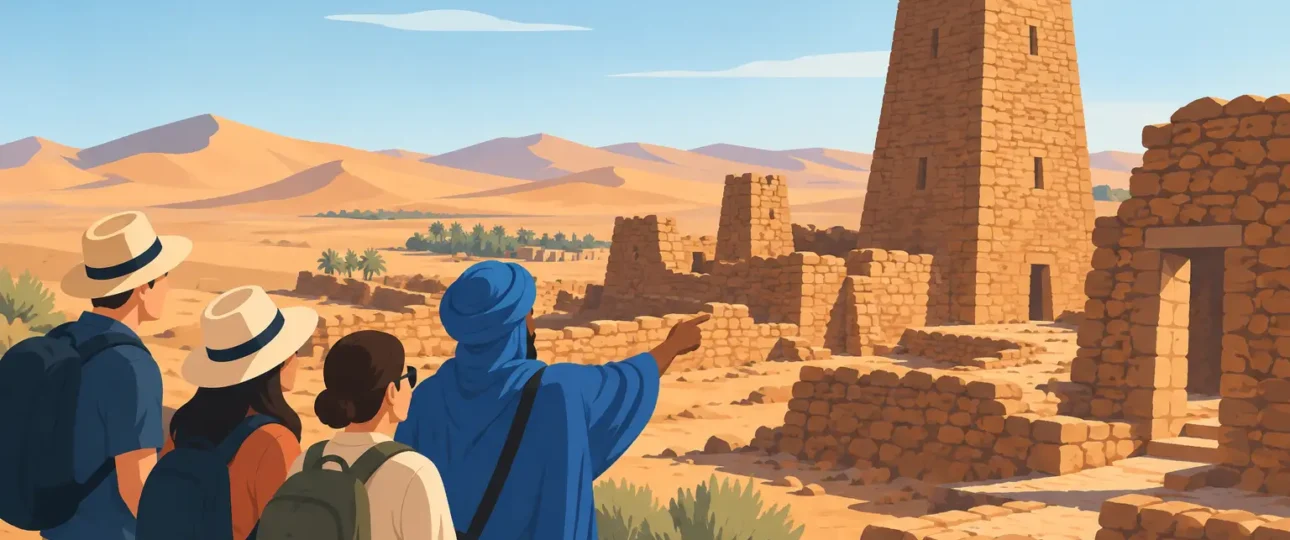
The first view of old Ouadane is not a staged attraction. Stone walls, narrow passages, and roofless homes rise from a rocky slope above the modern settlement, with the Adrar’s open desert stretching beyond them. A well-planned Ouadane ancient ruins guided tour gives this remarkable place the time and context it deserves, while taking care of the transport, local arrangements, and desert logistics that can be difficult to manage independently.
Ouadane rewards travelers who look beyond a quick photograph. Its ruins tell the story of a caravan town shaped by trade, scholarship, faith, drought, and changing routes across the Sahara. With a knowledgeable local guide, the silence of the old town becomes far more meaningful.
Why Ouadane’s Old Town Matters
Ouadane is one of Mauritania’s historic ksour, or fortified settlements, and forms part of the UNESCO-listed ancient towns of the country’s Saharan interior. Established centuries ago, it became an important stopping point for trans-Saharan caravans moving through the Adrar region. Salt, gold, textiles, books, and other goods passed through networks of towns like Ouadane, connecting West Africa with North Africa and beyond.
The town’s importance was never only commercial. Like nearby Chinguetti, Ouadane was tied to Islamic learning and to the social life of the caravan world. Its stone architecture was practical for the climate, but it also reflected a settled community in a landscape often associated only with nomadic travel.
Over time, shifting trade patterns and environmental pressures reduced Ouadane’s role. Families moved into the newer town below, leaving much of the older settlement exposed to wind, sand, and time. That is precisely why a visit feels so powerful. You are walking through a real historic place, not a reconstruction.
What an Ouadane Ancient Ruins Guided Tour Includes
A guided walk generally begins near the modern village, where a local guide can explain how the old and new settlements relate to one another. The route through the ruins is usually on uneven stone ground, with occasional loose surfaces and no polished visitor infrastructure. Good walking shoes, sun protection, and water are essential.
Your guide will lead you through remnants of homes, lanes, defensive walls, and communal spaces, pointing out features that are easy to overlook without local knowledge. From a distance, many structures can appear similar. Up close, you begin to notice the logic of the town: compact building patterns, carefully placed entrances, stonework adapted to heat, and views across the approaches to the settlement.
The pace matters. Ouadane is best experienced slowly, with time to stop, ask questions, and take photographs without feeling rushed back into a vehicle. For photographers and filmmakers, early morning and late afternoon offer softer light and stronger texture across the stone walls. Midday visits are possible, but the sun can be intense for much of the year.
A responsible guide also helps visitors treat the site with care. These are fragile ruins, not a place for climbing walls or entering unstable structures. Following local guidance protects both the visitor and a heritage site that has endured for centuries.
The value of local interpretation
A guide does more than identify old buildings. They provide the human details that turn a walk into an encounter with place: how caravan travel worked, why water and food storage mattered, what changed when trade routes shifted, and how local families remain connected to the town’s history.
Interpretation can vary depending on your interests. Culture-focused travelers may want more time on the town’s religious and scholarly role. Photographers may prioritize angles, light, and access timing. Travelers on a wider Adrar itinerary may prefer a focused visit before continuing to desert camps, Chinguetti, Terjit, or the Richat Structure. A private or small-group arrangement makes it easier to shape that balance.
How Ouadane Fits Into an Adrar Journey
Ouadane is not usually a destination reached casually by public transport. Most travelers visit as part of a multi-day route through the Adrar, commonly beginning from Atar or included within a longer Mauritania itinerary. Road conditions, desert distances, fuel planning, and the availability of comfortable overnight stays all need attention.
That is where an organized journey changes the experience. Rather than negotiating vehicles, finding reliable drivers, or guessing where to stay after sunset, you can focus on the route itself. A dependable ground team handles transport coordination, accommodation, and local arrangements so the day has a clear rhythm from arrival to departure.
For many visitors, Ouadane pairs naturally with Chinguetti. The two towns share a place in Mauritania’s caravan heritage, yet they feel distinct. Chinguetti is often associated with manuscript libraries and its celebrated mosque, while Ouadane offers a more expansive ruined settlement and a strong sense of a town gradually reclaimed by the desert.
Ouadane can also be combined with a visit toward the Richat Structure, widely known as the Eye of the Sahara. The two experiences complement each other: one reveals human history on the desert’s trade routes, the other shows the vast geological scale of the Adrar. The practical trade-off is time. Trying to fit both into one hurried day can reduce the value of each, especially during hot weather or when road conditions require a slower schedule.
Planning for Comfort and Safety
Remote travel in Mauritania is rewarding because the landscapes remain open, quiet, and lightly developed. It also requires realistic planning. Mobile coverage can be inconsistent outside towns, distances between services are significant, and temperatures vary sharply between daytime and night, particularly in cooler months.
For an Ouadane visit, choose an itinerary with a suitable vehicle, an experienced driver, sufficient drinking water, and overnight arrangements confirmed in advance. A clean, welcoming, and secure guesthouse in town can be the right choice for travelers who want a bed and facilities after a day on the road. A desert camp adds a more adventurous night under the stars, but it may be better suited to travelers comfortable with simpler facilities.
There is no single best choice. Families, first-time Sahara travelers, and those with limited time often appreciate a structured route with secure lodging. Experienced adventure travelers may prefer a longer desert extension and more time away from towns. In either case, clear planning makes a remote itinerary feel accessible rather than uncertain.
When to Visit Ouadane
The cooler travel season, broadly from late autumn through early spring, is generally the most comfortable period for walking through the ruins and traveling across the Adrar. Days can still be warm under clear skies, while evenings may become surprisingly cool. Layers are useful, especially if your itinerary includes camping.
Warmer months bring stronger heat and require earlier starts, more frequent breaks, and a careful approach to hydration. They can still work for well-prepared travelers, particularly those with fixed schedules or professional filming plans, but the daily rhythm should be adjusted around the sun.
Weather and desert conditions can influence timing at any point in the year. A local team that monitors routes and communicates clearly is more valuable than a rigid schedule. Flexibility is part of traveling well in the Sahara.
Make Time for the Details
The ruins are the central reason to come, but do not treat Ouadane as a box to check between larger attractions. Notice the transition from the living town to the abandoned stone lanes. Listen for the wind moving through empty doorways. Look outward from the higher ground and imagine caravan travelers arriving after days across the plateau.
Bring a camera, but leave room for observation without one. The strongest memory of Ouadane is often not a single monument. It is the scale of the settlement, the texture of the stone, and the realization that this quiet place once stood within one of the Sahara’s great networks of movement and exchange.
Tours in Mauritania can arrange an Ouadane visit as part of a well-supported Adrar itinerary, with local transport, experienced guiding, selected accommodations, and clear pricing handled before you arrive. That preparation leaves you free to give the old town what it asks for: unhurried attention.