Mauritania Cultural Etiquette for Travelers
You feel it quickly in Mauritania – hospitality is generous, social customs matter, and small gestures carry real weight. For anyone planning a guided trip, understanding Mauritania cultural etiquette for travelers is less about memorizing rules and more about moving through the country with respect, ease, and confidence.
That matters whether you are walking through Nouakchott markets, meeting families in the Adrar, or spending a night in a desert camp near Chinguetti. Most visitors are welcomed warmly, especially when they show patience, modesty, and genuine interest. You do not need to be perfect. You do need to be observant.
Mauritania cultural etiquette for travelers starts with respect
Mauritania is deeply shaped by Islam, strong family ties, and local traditions that can feel more formal than what many international travelers are used to. Daily life is not performative or staged for visitors. That is part of what makes the country so memorable, but it also means travelers should not assume the social norms will bend to outside habits.
In practice, respect here often looks quiet rather than dramatic. It means greeting people before asking a question. It means dressing with care, especially outside the capital. It means accepting that some moments are not for photography, and that not every interaction needs to be rushed.
If you are traveling on a structured itinerary, a good local guide helps bridge the gap. They can explain when customs are flexible, when they are not, and how expectations may differ between Nouakchott, small towns, and remote desert communities.
Greetings matter more than you might expect
In Mauritania, greetings are not a formality to skip. They are the opening of respectful interaction. If you walk up to someone and move straight to a request, it can come across as abrupt even if you mean well.
A polite greeting before any question is the safer approach. In French-speaking settings, a simple bonjour is often appropriate. In Arabic-speaking contexts, a greeting such as salam alaikum may be used and is generally appreciated when offered sincerely. If you are unsure, follow your guide or listen first.
These exchanges can take a little time. Someone may ask about your health, your journey, or how you are finding Mauritania before the conversation gets to the practical point. That is normal. In many situations, this is not small talk to get through quickly. It is the interaction.
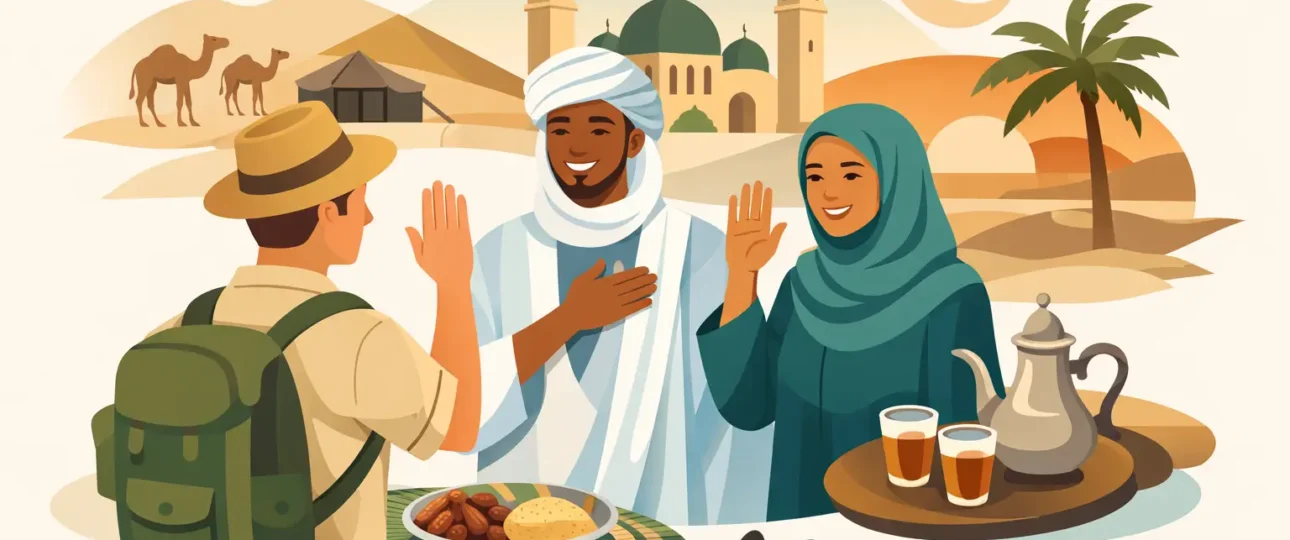
Handshakes are common between men. Between men and women, customs can vary more. Do not assume a handshake is expected across genders. A slight nod, a hand over the heart, or simply waiting to follow the other person’s lead is often the most respectful choice.
Dress modestly and read the setting
Clothing choices shape first impressions in Mauritania more than many travelers expect. The practical rule is simple: modest dress works almost everywhere, while revealing or tight clothing can feel out of place, especially in traditional areas.
For women, loose clothing that covers shoulders, chest, and knees is the safest option. Long skirts, loose pants, and lightweight long-sleeved tops are useful in both towns and desert environments. A headscarf is not always required for foreign visitors, but carrying one is smart. It can be useful in religious settings, windy desert conditions, or more conservative communities.
For men, sleeveless tops and very short shorts are best avoided outside hotel or camp settings. Lightweight long pants and T-shirts or long-sleeved shirts are more respectful and usually more practical in the sun.
There is some flexibility in tourist areas and private camps, but not every part of Mauritania feels the same. Nouakchott is more mixed in style than smaller towns. Remote settlements in the Adrar are generally more conservative. When in doubt, dress one level more modestly than you think you need.
Photography needs permission, not assumptions
Mauritania offers extraordinary visual moments – desert light, ancient towns, camel caravans, fishing scenes, market life. For photographers and filmmakers, that is part of the draw. But cultural etiquette matters here just as much as composition.
Do not photograph people, especially women, without permission. In some communities, being photographed can feel intrusive or unwelcome. Children may wave at the camera, but that is not the same as family consent. A guide can help ask in the right way and read the response clearly.
Military sites, police posts, government buildings, border areas, and certain infrastructure should also be treated carefully. Even where there is no visible sign, photographing sensitive locations can create unnecessary problems. If you are traveling for serious photography or filming, it helps to work with local support that can advise on permits and practical limits before you arrive.
There is also a judgment call involved. Sometimes a scene is visually strong but socially private. Prayer, grief, and close family moments are best left undocumented unless you have been invited into that space.
Tea, hospitality, and the value of slowing down
In Mauritania, hospitality is not a side detail. It is part of the culture’s backbone. If tea is offered, the invitation often means more than the drink itself. Refusing politely may be fine in some cases, but accepting when you can is often the warmer path.
Traditional tea service can take time. That is the point. Conversation unfolds around it. If you are used to tightly scheduled travel, this can feel slow at first. Then it starts to feel like one of the best parts of the experience.
You do not need to overperform gratitude, but you should show it clearly. Accept with thanks, sit with patience, and avoid acting as though hospitality is delaying the real event. Often, it is the real event.
If food is shared, follow local cues. In some settings, eating with the right hand is expected. If you are unsure where to sit, how to start, or whether a dish is shared communally, let your hosts or guide lead. People are generally generous with respectful visitors, but effort counts.
Public behavior and religious sensitivity
Mauritania is not a place where loud, highly casual tourist behavior lands well. Public affection should be kept minimal. Drinking alcohol in public is not appropriate, and travelers should be aware that the country is culturally and legally conservative around it.
During prayer times, daily rhythms may shift. You do not need to participate, but you should avoid interrupting prayer or treating it as a spectacle. Mosques and religious spaces should be approached with sensitivity, and entry may not always be open to non-Muslims. Ask first rather than assuming access.
Ramadan is a special case. Travel remains possible and rewarding, but etiquette becomes more important. Eating, drinking, or smoking in public during fasting hours can be considered disrespectful. In private or designated traveler settings, arrangements are usually manageable, especially with organized local support. Publicly, discretion matters.
Gender norms vary by context
One of the more nuanced parts of Mauritania cultural etiquette for travelers is understanding gender dynamics without reducing the country to a stereotype. Social interactions between men and women are often more formal than in Europe or North America, but the setting matters.
In urban, professional, or tourism-related environments, interactions may feel relatively straightforward. In more traditional settings, a traveler may notice more separation in seating, conversation, or social roles. Neither response should be read too quickly. Local custom, family preference, age, and region all influence what feels normal.
For solo women travelers, modest dress and good local coordination make a real difference, not because travelers should be anxious, but because clarity and context help everything run more smoothly. For male travelers, respectful distance and restraint are just as important. Friendly does not need to mean familiar.
A few practical manners that go a long way
Punctuality can be more flexible in social settings than many international travelers expect, though transport logistics and guided departures should still be taken seriously. Patience is useful.
Use your right hand when offering, receiving, or eating where possible. Avoid pointing your feet directly at people when seated. Ask before entering private spaces. Keep your voice measured in villages and family compounds. These are small habits, but they signal awareness.
It also helps to avoid comparing Mauritania constantly to home. Curiosity is welcome. Judgment rarely is. If something feels unfamiliar, the better first question is usually, How does this work here?
A well-planned trip gives you room to absorb these details without stress. That is one reason many travelers choose organized support in Mauritania. At Tours in Mauritania, we handle the transport, permits, stays, and on-the-ground coordination so you can focus on the experience and meet people with the right context around you.
You do not need to arrive knowing every custom. Arrive willing to observe, greet people properly, dress with care, and let the rhythm of the place teach you a little. In Mauritania, that approach is noticed – and usually returned with remarkable generosity.