Iron Ore Train vs Desert Camp: Which Fits You?
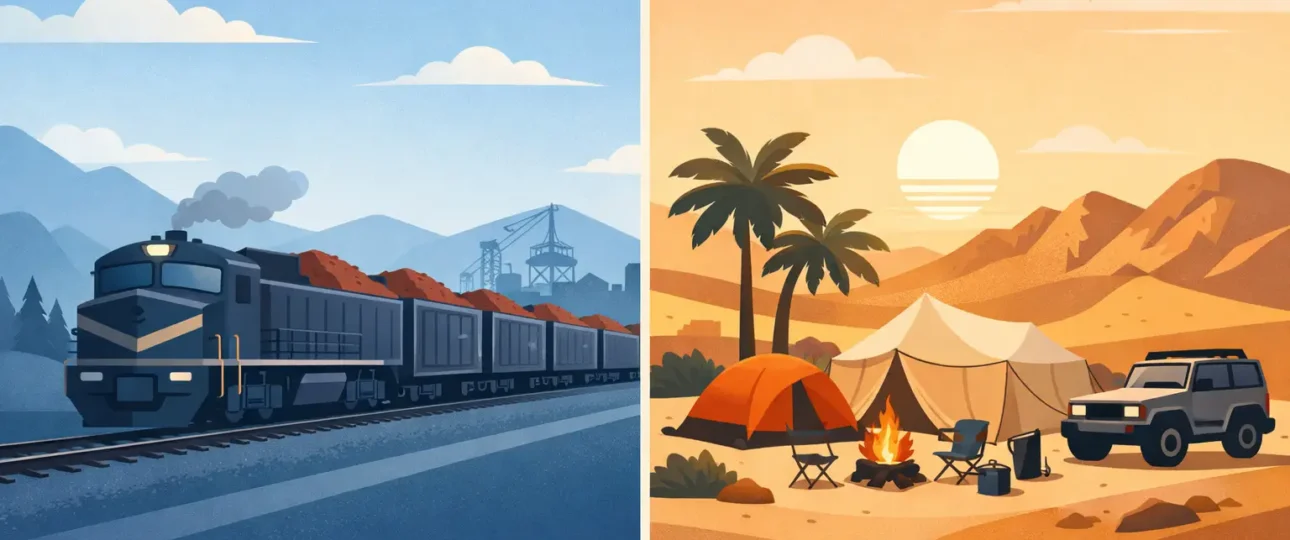
The iron ore train vs desert camp question is not really about choosing one night over another. It is about choosing the kind of story you want to carry home from Mauritania. One puts you on top of a working freight train under open sky, with wind, dust, and the vast Sahara moving around you. The other gives you time to settle into the desert, share a meal, sleep in a prepared camp, and wake to dunes lit by the first sun.
Both experiences are memorable. They simply ask different things of you – and reward you in different ways.
Iron Ore Train vs Desert Camp: The Core Difference
Mauritania’s Iron Ore Train is one of the world’s great rail adventures. The train carries iron ore from the mining town of Zouérat toward the Atlantic coast, and its length, route, and timetable are shaped by industrial operations, not sightseeing. Riding it is a real expedition: timing can change, conditions are exposed, and the journey requires flexibility.
A desert camp is built around a different rhythm. After a drive through the Adrar landscape or across the dunes, you arrive at a selected camp where bedding, food, drinking water, and a sheltered place to rest are prepared in advance. You still experience the silence and scale of the Sahara, but with a reliable overnight setup and a guide close at hand.
The train is about immersion in an uncompromising journey. The camp is about experiencing the desert with more comfort, time, and calm.
Choose the Iron Ore Train if You Want a True Expedition
For many travelers, the train is a signature reason to visit Mauritania. It is physical, photogenic, and unlike a conventional rail journey anywhere else. You may travel in an open ore wagon, often sitting or lying on a protective layer arranged for the ride, while dust settles over clothes, bags, and camera equipment.
That exposure is exactly why some travelers love it. There are no polished windows between you and the desert. As the light shifts from late afternoon to darkness and then to dawn, the journey feels elemental. Photographers and filmmakers often value the scale of the wagons, the texture of the iron ore, and the contrast between industrial movement and empty land.
But this is not a luxury experience with a fixed arrival time. Freight schedules can move slowly or change without much notice. Boarding arrangements, safety considerations, and the best place to meet the train need local coordination. Nights can be cold, daytime heat can be intense, and dust is unavoidable.
The train tends to suit travelers who are comfortable accepting a little uncertainty in exchange for a rare experience. It is a strong fit for seasoned adventure travelers, documentary crews, and anyone who can enjoy discomfort when it serves the story.
What the train ride feels like in practice
Expect a long, exposed journey rather than a scenic rail excursion with regular stops. You should bring warm layers, a face covering or scarf for dust, closed shoes, water, snacks, and protection for electronics. A small bag is more practical than trying to manage heavy luggage on and around the train.
A guided arrangement matters here. Your team can help plan transfers, select sensible boarding and pickup points, track the operational situation as closely as possible, and make sure you have a clear next step when you arrive. That support does not turn the train into a predictable hotel transfer. It does make a demanding experience far easier to approach responsibly.
Choose a Desert Camp if You Want the Sahara to Slow Down
A desert camp gives you something the train cannot: space to be still. Once the vehicle engines stop and the camp is set, you notice how quiet the desert can become. There may be tea by the fire, a simple freshly prepared dinner, a walk up a nearby dune, and a clear view of the stars away from city lights.
For culture-focused travelers, this setting also creates room for conversation. Your guide can explain the routes that once connected caravan towns such as Chinguetti and Ouadane, point out desert plants and tracks, or simply help you understand the landscape in front of you. The experience is less about pushing through conditions and more about being present in them.
A well-organized camp is not the same as a resort, and it should not be presented that way. The desert remains a remote environment. Facilities may be simple, and temperatures can shift sharply after sunset. Yet a clean sleeping arrangement, prepared meals, drinking water, and reliable transport make a meaningful difference, especially for first-time visitors to Mauritania.
Who enjoys desert camping most
Desert camps are particularly good for couples, small groups, families with capable older children, and travelers who want adventure without making every hour a test of endurance. They are also excellent for photographers who want time for sunrise, sunset, stars, and dune landscapes rather than shooting from a moving freight wagon.
If you are traveling on a structured multi-day itinerary, a camp night also provides a natural pause between long drives, historic towns, and desert crossings. You can experience the Sahara deeply while knowing the practical details have been handled.
Comfort, Safety, and Sleep: An Honest Comparison
The difference in comfort is clear. On the Iron Ore Train, you may sleep lightly, if at all, depending on the wagon, the weather, the noise, and the train’s movement. Dust is part of the experience, and personal space is limited. You should arrive expecting adventure first and rest second.
At a desert camp, sleep is usually more comfortable because bedding and a designated place to rest are provided. You may sleep in a tent or under the stars, depending on the camp setup and weather. A good operator will explain what is included before departure so you can pack appropriately and avoid surprises.
Safety also looks different in each setting. On the train, the main priority is careful planning around boarding, riding, and disembarking, as well as managing exposure to sun, cold, and dust. In the desert, the priorities are dependable vehicles, experienced drivers and guides, sufficient water, communication, route knowledge, and a camp selected with practical standards in mind.
Neither experience should be treated casually. The right local support makes them more accessible, but travelers still need to follow guidance, prepare honestly, and respect the conditions.
The Best Choice May Be Both
If your schedule allows, you do not have to frame the decision as a strict either-or. The Iron Ore Train and a Sahara camp complement each other remarkably well. One gives you a powerful, high-energy travel story. The other gives you recovery, perspective, and a chance to experience the desert without constantly moving through it.
A balanced Mauritania itinerary might include the train as a major adventure highlight, then a camp night in the Adrar region before or after visits to Chinguetti, Ouadane, or the Richat Structure area. This pacing is especially useful after a long train journey, when a hot meal, an organized transfer, and a proper place to rest matter more than you expected.
Tours in Mauritania can organize the transport, local logistics, and overnight arrangements around both experiences, so you are not left trying to coordinate changing train operations or remote desert stays on your own. Clear planning is valuable in a country where the most memorable routes are often the least conventional.
How to Decide Before You Book
Choose the Iron Ore Train when the uncertainty, dust, and physical reality of the journey sound exciting rather than discouraging. It is for travelers who want to say yes to an experience precisely because it cannot be polished into something ordinary.
Choose a desert camp when you want broad skies, dunes, local hospitality, and an overnight experience that feels adventurous while remaining more comfortable and structured. It is the better choice if sleep, steady pacing, or a calmer setting are priorities.
If you are unsure, consider your reaction to this simple question: would you rather spend the night moving through the Sahara on a freight wagon, or wake up already surrounded by quiet dunes? There is no lesser answer. Mauritania has room for both kinds of adventure, provided the journey is planned with respect for the landscape and for your own travel style.