Mauritania Tours vs Independent Travel
You can absolutely try to piece together Mauritania on your own. Some travelers do. But when people compare mauritania tours vs independent travel, the real question is not whether both are possible. It is how much uncertainty, negotiation, and on-the-ground problem-solving you want to carry while moving through one of West Africa’s most remote and rewarding destinations.
Mauritania is not difficult because it lacks beauty or interest. It is difficult because the country asks more of the traveler. Distances are long. Infrastructure is limited outside key routes. Reliable transport can be inconsistent. Language can become a barrier fast if you do not speak Arabic or French. And many of the experiences people come for – desert crossings, remote camps, Chinguetti, Ouadane, Banc d’Arguin, or the Iron Ore Train – become much easier and safer with local coordination.
That does not mean independent travel is wrong. It means the better choice depends on your travel style, your risk tolerance, and what kind of trip you actually want to have once you arrive.
Mauritania tours vs independent travel: what changes on the ground?
On paper, the difference looks simple. A tour gives you a fixed itinerary, transport, lodging, guide support, and usually permit handling. Independent travel gives you freedom, flexibility, and the chance to move at your own pace.
On the ground, the gap is bigger than that.
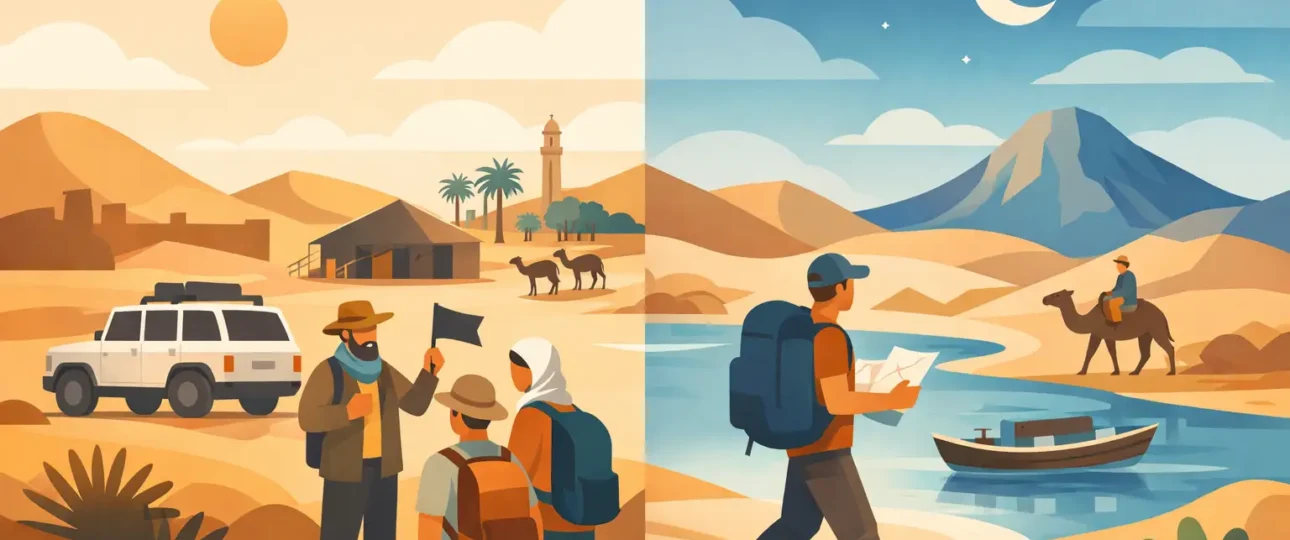
A guided tour turns Mauritania into a travel experience. Independent travel can turn it into a logistics project. If you enjoy building routes from scratch, arranging drivers, checking road conditions, finding guesthouses, and adapting when plans shift, independent travel may suit you. If you would rather spend your energy watching dunes change color at sunset, talking with locals in old caravan towns, or setting up your camera instead of sorting transport, a tour usually makes more sense.
This is especially true in a destination where the best-known places are spread out and often require more than just showing up. Desert camps need preparation. Remote routes need vehicles that can handle sand and long distances. Some areas are simply more comfortable to visit when someone local has already organized the route, the timing, and the overnight stops.
Safety and predictability matter more in Mauritania
Many travelers are comfortable traveling independently in places with dense tourist infrastructure. Mauritania is different. It rewards preparation.
The biggest advantage of a tour is not just convenience. It is predictability. You know who is meeting you, how you are getting to the next destination, where you are sleeping, and who to call if something changes. That matters in a country where transportation links are not always built around tourist schedules and where remote travel can quickly become tiring if the planning is weak.
A good local operator also reduces small but stressful risks. You are less likely to end up in unsuitable accommodation, overpaying for transport, or wasting valuable days trying to confirm basic arrangements. You also have someone who understands local expectations, route realities, and practical safety decisions.
Independent travelers can manage these things, of course. Experienced overlanders and slow travelers often do. But they usually succeed because they accept that the trip will involve more friction. If your idea of adventure includes uncertainty, that may be part of the appeal. If your idea of adventure is sleeping under the stars after a well-run desert crossing, that is a different calculation.
Cost: cheaper in theory, not always in practice
Independent travel often looks cheaper at first. You may assume that booking transport as you go, choosing basic accommodation, and avoiding a guide will reduce your budget. Sometimes it does.
But Mauritania has a way of narrowing that gap. Private transfers over long distances are expensive when arranged ad hoc. A 4×4 for desert routes is not a casual expense. Last-minute accommodation decisions can limit your options. Delays can create extra overnight costs. And if you need to fix a planning mistake on the road, the cheaper option can suddenly become the more expensive one.
Tours usually cost more upfront, but they are easier to budget for because key services are bundled together. You know what transport, lodging, guiding, and route support will cost before arrival. For many travelers, especially those visiting for a limited number of days, that clarity matters as much as the headline price.
This is one of the biggest misunderstandings in the mauritania tours vs independent travel debate. Independent travel can save money, but it does not always save value. If a tour helps you see more, lose less time, and avoid preventable problems, the price difference may feel smaller than expected.
Access to the experiences people actually come for
Most travelers do not come to Mauritania just to move between cities. They come for signature experiences.
The Adrar region is one example. Reaching desert landscapes, ancient settlements, and camp locations smoothly usually depends on good vehicle support and local route knowledge. Chinguetti and Ouadane are far more rewarding when your time there is not squeezed by transport uncertainty. The Iron Ore Train journey can be done independently, but many travelers prefer support around timing, access points, gear planning, and onward logistics once the ride ends.
The same goes for photographers, filmmakers, and travelers with a short window. If you need to be in the right place at the right time, with permits handled and transportation ready, guided support is not a luxury. It is the structure that makes the trip workable.
Independent travel is better suited to travelers whose main goal is openness rather than coverage. If you are happy to spend extra days adjusting, waiting, and changing plans, you can create your own path. But if your trip is built around specific landscapes and landmark experiences, organized tours tend to deliver more reliably.
Comfort is not about luxury. It is about energy.
In Mauritania, comfort often means something practical. A clean guesthouse. A secure desert camp. A driver who knows the route. Airport pickup that happens on time. A clear plan for where meals and water are coming from during long travel days.
Those details shape the entire trip. When they are handled well, you arrive at each stop with enough energy to appreciate where you are. When they are not, the trip can start to feel like a string of tasks instead of an experience.
This is where a well-run tour quietly changes everything. It removes background stress. You are not constantly making decisions about transport, timing, or whether the next overnight stop will be acceptable. You can focus on the country itself.
For many travelers, that is the difference between a trip they admire and a trip they genuinely enjoy.
Who should choose independent travel?
Independent travel makes sense for a specific kind of visitor. If you have time, strong travel experience in lower-infrastructure destinations, and patience for ambiguity, you may appreciate the freedom. It can work especially well for travelers who speak useful regional languages, have local contacts, or are comfortable rearranging plans in real time.
It also suits people who do not mind missing a few things. That may sound odd, but it matters. Independent travel is easier when you are not attached to a tight list of must-see places. Flexibility helps most when your expectations are flexible too.
If you are traveling very slowly, on a highly controlled budget, or combining Mauritania with a broader overland journey, independent travel may fit naturally.
Who should choose a tour?
A tour is usually the better choice if Mauritania is a once-in-a-lifetime destination, if your trip is relatively short, or if you want to see remote highlights without spending half the trip managing the route.
It is also the stronger option for solo travelers seeking reassurance, for couples or small groups who want safe and efficient arrangements, and for photographers, media teams, and adventure travelers who need a reliable local partner. In these cases, the support is not just about ease. It protects the quality of the trip.
That is why many visitors choose operators such as Tours in Mauritania. The value is not simply that someone books hotels or drives the vehicle. It is that bookings, transport, permits, and local support are already aligned, with clear pricing and no surprise fees. In a place like this, that level of organization creates freedom of a different kind.
The better question is how you want to feel on the trip
When people ask whether tours or independent travel are better, they often focus on ideology. Freedom versus structure. Adventure versus comfort. But Mauritania is not a place where those categories stay neat.
A tour can still feel adventurous. You can cross dunes, sleep under stars, ride the Iron Ore Train, and stand in ancient towns that feel untouched by modern pace. Independent travel can still feel restrictive if too much of your attention goes to transport fixes and basic arrangements.
So ask a more useful question. Do you want to spend your trip managing the framework, or living inside the experience?
If you love building every mile yourself, Mauritania will give you a real challenge and a real reward. If you want the country at its strongest – bold landscapes, deep history, and remote travel made accessible with solid local support – a well-planned tour is usually the smarter path.
The best trips here are not the ones that prove how tough you are. They are the ones that leave enough space for wonder.