
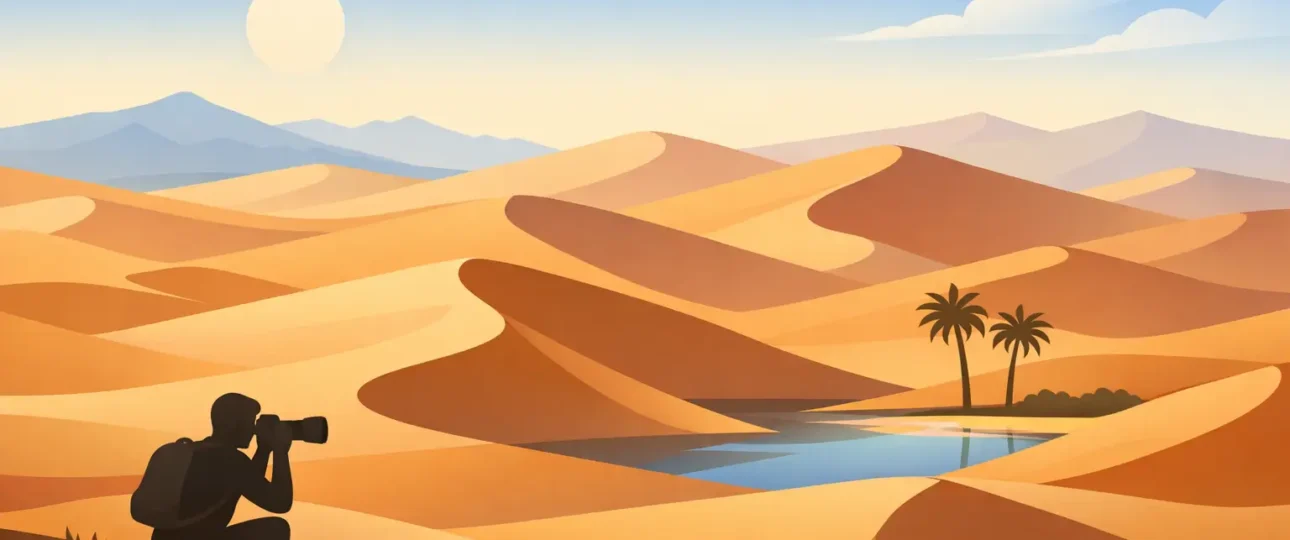
Best Places to Photograph Mauritania Dunes
A Mauritanian dune rarely looks like a perfect wave at noon. The sand can appear pale, flat, and almost featureless until low sun draws a dark edge across every ridge. That is why the best places to photograph Mauritania dunes are not simply the biggest fields of sand. They are places where form, light, access, and a well-timed overnight camp come together.
For photographers and filmmakers, Mauritania offers a remarkable range in a relatively compact desert journey: wind-sculpted ridges near caravan towns, towering dunes beside green oases, and wide open horizons where there is no trace of modern life. The rewarding locations are remote, though, and reaching them comfortably requires the right vehicle, local route knowledge, water planning, and a camp schedule built around the light.
Best Places to Photograph Mauritania Dunes
The Amatlich Dunes between Chinguetti and Ouadane
The Amatlich dune field is the essential landscape for broad, cinematic Sahara images. Situated in the Adrar region between Chinguetti and Ouadane, it delivers long chains of crests, clean curves, and generous separation between dunes. From a high ridge, you can frame repeating patterns that fade into the horizon. At ground level, a single wind-carved face can fill the image with texture.
This is strongest at sunrise, when shadows make the ridges look sharper and footprints are easier to avoid. Sunset can be equally beautiful, particularly when the final light warms the sand, but camp and vehicle tracks may be more visible after a busy afternoon. A local guide can choose a quieter approach and position camp away from the most photographed access points.
Amatlich is also one of the best places for a night in the desert. After dusk, the lack of artificial light makes it suitable for star-filled frames above a low dune line. Bring a stable tripod, a headlamp with a red setting, and protection for your camera from fine sand. Conditions change quickly after dark, so keep lenses and batteries organized inside a closed bag.
The Dunes Around Terjit Oasis
Terjit offers a contrast that makes desert photographs feel distinctly Mauritanian rather than generically Saharan. Palm trees, rock walls, spring-fed pools, and orange dunes can appear within the same sequence of images. It is a useful location for travelers who want to photograph sand while also adding scale, life, and color variation to a portfolio.
The most effective compositions usually show the meeting point between dune and oasis. A line of palms beneath a sand slope tells a stronger story than an isolated dune alone. Early morning is calmest and more comfortable for walking with equipment. Later in the day, light catches the warm rock and can work well for environmental portraits, provided you seek shade and respect local privacy.
Terjit is easier to pair with secure lodging and practical facilities than a remote wild camp. That makes it a sensible choice for photographers traveling with several camera bodies, drones where permissions allow, or filming equipment that needs careful charging and storage. The trade-off is that it feels less empty than Amatlich. Its value lies in contrast, not pure isolation.
Chinguetti’s Encroaching Sand
In Chinguetti, dunes do more than create a beautiful backdrop. They reveal the ongoing relationship between the Sahara and one of Mauritania’s historic caravan towns. Sand presses against old walls, slips into lanes, and rises behind the mud-brick architecture. This is where landscape photography can become cultural storytelling.
Work with a guide who knows the town and can help you photograph respectfully. Avoid treating homes, residents, or religious spaces as scenery. If you plan portraits, ask first and allow time for a real exchange. The strongest images often come from pairing a distant dune with the town’s geometric walls, a doorway, or a traveler walking along the edge of the sand.
Photograph the dunes outside town at first light, then use the softer late-afternoon light in the historic streets. This rhythm keeps your desert work focused on the hours that matter while leaving room to experience Chinguetti properly. It also reduces the temptation to drive across fragile areas simply to chase a view.
The Ouadane Plateau and Desert Edge
Ouadane is not a classic sea of high dunes in every direction. Its strength is the tension between stone, sand, and enormous space. The ancient settlement sits in a rugged landscape where pale plateaus, dark rock, and advancing dunes create more layered compositions than a pure sand field.
For photographers, this is a place to work wider. Use a person, vehicle, or camel caravan at a respectful distance to establish scale, then let the plateau lead the eye toward the dunes. The low side light of late afternoon can separate rock textures from the softer sand. After rain, which is uncommon but possible, the color contrast can be especially striking.
Ouadane also works well for travelers interested in a structured Adrar route. It gives you access to a historic town, nearby desert scenery, and onward travel toward remote camps without trying to force every photographic goal into one stop.
The Dunes Near Tergit and the Adrar Desert Tracks
Beyond the specific oasis viewpoint, the desert tracks of the Adrar open access to smaller, less formal dune scenes. These are often the images travelers remember most: a lone acacia at the base of a slope, delicate ripples untouched by footsteps, or a vehicle disappearing behind a ridge. The exact locations are not always marked on maps, and that is part of their appeal.
They are also where independent planning becomes least reliable. Sand conditions, route choices, and daylight distance all matter. A capable 4×4 and an experienced desert driver are essential, not optional. The right guide can stop when the light is good, adjust the route after wind changes the surface, and select a camp that is scenic without exposing guests to unnecessary risk.
How to Plan for Better Dune Images
The best photographs are usually made at sunrise and in the final 90 minutes before sunset. Plan your driving, meals, and camp setup around those windows. Midday is better reserved for transfers, rest, lens cleaning, or scouting a foreground for the next session.
A standard zoom and a telephoto lens are both useful in Mauritania. Wider focal lengths show the sweep of a dune field, while a telephoto compresses layered ridges and isolates abstract lines. A small microfiber cloth, blower, rain cover or simple dust cover, and spare batteries should stay close at hand. Never change lenses in a strong wind if you can avoid it.
Footprints are a practical issue. Walk around the frame rather than through it, and photograph untouched slopes first. If you are traveling with a group, agree on a direction of movement before the light arrives. This small piece of coordination can protect an otherwise perfect foreground.
People can add meaning and scale, but use them intentionally. A walker on a distant crest, dressed in a color that separates from the sand, may make a powerful frame. A crowded line of people near the camera usually reduces the quiet geometry that makes dunes compelling. The same principle applies to vehicles: position them only where they support the story of the landscape.
Safety, Access, and the Value of Local Support
Remote dunes are beautiful because they are remote. That also means there may be no signage, phone coverage, fuel station, or easy recovery option nearby. Heat, soft sand, navigation, and changing weather demand calm preparation. Travelers should carry water, sun protection, closed footwear, and layers for cold desert nights, even when daytime temperatures are high.
For a photography-focused trip, communicate your priorities before departure. Tell your guide whether sunrise shots, night photography, filming, portraits, or drone work are central to the journey. Timing can then be built into the itinerary rather than added as an afterthought. Drone use may require permissions and can be restricted in sensitive locations, so never assume it is available.
Tours in Mauritania can organize transport, permits, desert camps, and knowledgeable local guiding so the operational details do not steal time from the light. That support matters most when plans need to shift: a better camp position, an earlier departure, or a route change after the wind reshapes the sand.
Leave space in your schedule for the unexpected. A dust haze may soften one sunset, while the next morning reveals razor-sharp shadows across an untouched ridge. In Mauritania, patience is not time lost. It is often the difference between seeing a dune and making an image that carries the silence of the Sahara home with you.