Review: Mauritania Guided Desert Expedition
A review of a Mauritania guided desert expedition should begin with the reality of the country: the distances are long, the Sahara is vast, and the most memorable places are often far beyond paved roads. Watching the last light settle over the dunes near the Adrar, walking through the quiet lanes of Chinguetti, or sleeping beneath a sky without city glow can feel wonderfully remote. Reaching those moments comfortably and safely takes local planning, reliable vehicles, and a guide who understands the terrain.
This is not a destination where a good expedition is measured only by the number of sights on an itinerary. It is measured by whether transport arrives as planned, whether permits and desert routes are handled calmly, whether camp feels welcoming after a long drive, and whether travelers have space to experience Mauritania rather than manage its logistics.
What a Guided Desert Expedition in Mauritania Feels Like
A well-designed journey moves at the pace of the landscape. One day may begin in Nouakchott, with the Atlantic air and the activity of the capital, before the road leads north and east toward the sandstone plateaus of Adrar. The scenery gradually changes: roadside villages become open hamada, then escarpments, palm-filled oases, and sand that reaches to the horizon.
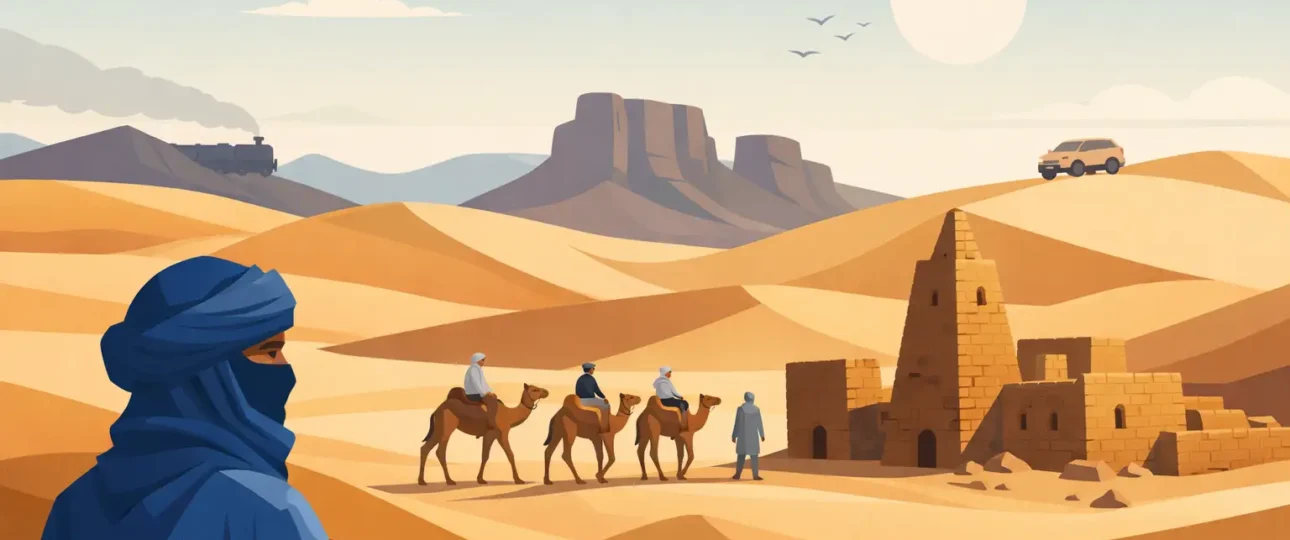
The desert is not one uniform place. In Mauritania, a guided route can combine high dunes, rock plains, dry riverbeds, date palms, mountain passes, and ancient settlements shaped by trans-Saharan trade. That variety is a major reason to travel with a guide rather than simply drive toward the sand. The route is part of the experience, and local knowledge determines where it is sensible to stop, when conditions call for a different track, and how to balance adventure with a manageable day.
For many travelers, Chinguetti is an emotional high point. Its old town, built in earth tones beneath the desert light, speaks to centuries of scholarship and caravan travel. Ouadane offers a different atmosphere: wider horizons, ancient stone ruins, and a powerful sense of distance. Neither place needs to be rushed. A thoughtful guide gives travelers time for photographs, conversation, and the small details that make these towns more than a checkpoint on a map.
Review: Mauritania Guided Desert Expedition Logistics
The strongest part of a guided expedition is often the work travelers barely see. Mauritania rewards curiosity, but it can be operationally demanding for independent visitors. Road conditions change, fuel and supplies need planning, and remote areas do not offer the same backup options found on more established tourist routes.
A dependable local operator handles airport transfers, vehicle coordination, accommodation reservations, camp setup, and the permits required for the route. This allows travelers to arrive with a clear plan instead of spending the first day negotiating transport or trying to understand what is realistically possible. For a short visit, this can be the difference between seeing Mauritania and merely passing through it.
At Tours in Mauritania, the goal is to make the expedition feel adventurous, not uncertain. We handle bookings, transport, and permits so you do not have to, while keeping the itinerary transparent and the support close at hand. A clear price with no surprise fees matters even more in a remote destination, where last-minute changes can otherwise become costly and stressful.
Guiding also brings a human advantage. An English-speaking local guide can explain the history behind a ksar, help travelers understand daily life in the villages they visit, and introduce the customs that make a respectful visit easier. The best guides do not turn every stop into a lecture. They know when to offer context, when to make practical decisions, and when to let silence do the work.
Comfort in the Desert Is Practical, Not Fancy
Desert comfort is not about recreating a city hotel in the dunes. It is about getting the essentials right after a full day of travel: clean bedding, good food, safe drinking water, a camp arranged with care, and a team that is prepared for the night ahead.
Sleeping under the stars is often one of the expedition’s defining experiences. The air cools quickly after sunset, conversation softens, and the scale of the night sky becomes almost difficult to absorb. Yet this is where practical standards matter. Travelers should know what sleeping arrangements are provided, how meals are prepared, what level of privacy is available, and whether the camp team can accommodate dietary needs when notified in advance.
There is a trade-off to accept. Remote camps are beautifully simple, and some guests will find that simplicity freeing. Others may prefer a route with more guesthouse nights, regular showers, and fewer consecutive nights in the open desert. Neither preference is wrong. The right itinerary depends on your experience, comfort expectations, season, and the amount of time you have in Mauritania.
Safety Depends on Preparation and Judgment
Mauritania’s desert should be approached with respect, not fear. A guided trip is reassuring because the team plans for the realities of remote travel: sufficient water, vehicle checks, communication arrangements, route knowledge, and a sensible daily schedule. In hot months, departure times and driving hours may need adjusting. In cooler months, warm layers become essential once the sun drops.
Travelers also have a role to play. Arrive with sun protection, a refillable water bottle, light layers for daytime, something warm for camp evenings, and footwear suitable for sand and uneven ground. Keep expectations flexible. Desert travel is shaped by wind, weather, road conditions, and the pace of life outside major cities. A guide who changes a route for safety or timing is not taking away from the journey. They are protecting it.
For photographers and filmmakers, local coordination is especially valuable. The most striking scenes often occur at changing light, far from services, where timing, access, and vehicle placement all matter. A guide can help build realistic shooting time into the route while keeping the wider expedition moving safely.
Who Will Get the Most From This Journey?
This kind of expedition suits travelers who value place over convenience. You do not need to be an extreme adventurer, but you should be comfortable with long drives, limited connectivity, sand in unexpected places, and plans that occasionally shift with conditions. In return, you gain access to landscapes and cultural sites that do not feel staged for visitors.
It is particularly rewarding for culture-focused travelers, photographers, small groups, and people who have long wanted to experience the Sahara with experienced support. Motorcycle travelers can also benefit from local route knowledge and organized logistics, especially when crossing long, lightly serviced stretches. Families or first-time desert travelers may prefer a private or paced itinerary with more lodge nights and shorter driving days.
The question is not whether Mauritania is “easy.” Its appeal is that it remains real, spacious, and deeply different from conventional vacation destinations. The right guided expedition makes that difference accessible without pretending it does not exist.
If the image that stays with you is a campfire fading into a field of stars, a caravan town appearing beyond the dust, or the first footsteps on untouched dunes, give the journey enough time. Choose a route built around care as well as adventure, and let Mauritania reveal itself one well-planned day at a time.