Do I Need a Guide in Mauritania?
If you are asking do I need a guide in Mauritania, you are probably already drawn to the exact parts of the country that make travel here so memorable – vast dunes, remote desert tracks, old caravan towns, the Iron Ore Train, and long stretches where there is very little room for guesswork. Mauritania rewards independent-minded travelers, but it is not a destination where logistics are casual. For many routes, a guide is not just helpful. It is the difference between spending your trip experiencing the country and spending it solving problems.
Do I need a guide in Mauritania for most trips?
The honest answer is: it depends on how you want to travel, where you want to go, and how comfortable you are with uncertainty.
If your plan is limited to a short stay in Nouakchott, a guide is not always essential. A confident traveler who is used to West African capitals, comfortable arranging local transport, and happy to keep plans flexible can move around parts of the city without a full-time guide. Even then, many visitors still prefer local support for airport transfers, language help, and smoother planning.
Once you move beyond the capital, the case for guided travel becomes much stronger. Mauritania is a country of long distances, sparse infrastructure, limited signage, changing road conditions, and destinations that are often far from simple point-to-point travel. Reaching places like Chinguetti, Ouadane, the Adrar region, Banc d’Arguin, or a remote desert camp usually involves more than renting a vehicle and following a map.
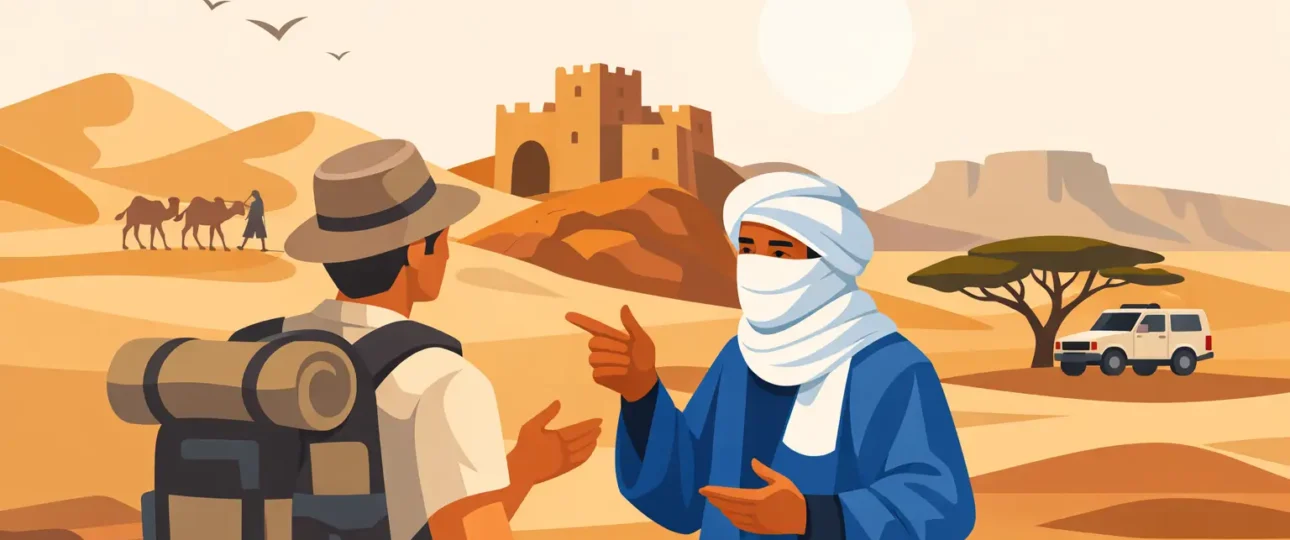
A good guide does not just interpret history. They help manage timing, route decisions, local coordination, checkpoints, cultural expectations, and practical issues that most first-time visitors do not see coming.
Where independent travel gets harder
Mauritania is not difficult in the same way as crowded or overdeveloped destinations. It is difficult because it is remote, lightly serviced, and often unforgiving if a plan starts to slip.
Transport is one of the biggest factors. Distances are long, public transport is inconsistent for travelers on a schedule, and self-driving outside straightforward paved routes can quickly become complicated. In the desert and on secondary routes, navigation is local knowledge as much as it is geography. A wrong turn is not always a quick correction.
Then there is the question of timing. In Mauritania, daylight, heat, road conditions, and service availability matter. So does fuel planning. So does knowing which guesthouse is actually clean and ready to receive you, not just theoretically open. Travelers often underestimate how much energy goes into confirming the basics.
That is why guided trips feel different here. When transport, accommodation, permits, and local coordination are handled for you, the country becomes more accessible without losing its edge.
Safety is not just about risk – it is about response
Many travelers ask about safety as if the only issue is personal security. In Mauritania, safety is broader than that.
It includes vehicle reliability on long road sections. It includes knowing what to do if a route changes, a checkpoint asks questions, or a traveler becomes unwell far from major services. It includes understanding which overnight stops are genuinely comfortable and secure. It also includes avoiding small planning mistakes that grow larger in remote areas.
This is where a reliable guide or local operator adds real value. The benefit is not drama prevention alone. It is having someone who already knows the terrain, the rhythm of travel, and the local systems. That kind of support saves time, reduces stress, and gives travelers more confidence to enjoy places that might otherwise feel too complex.
For solo travelers and first-time visitors in particular, guided travel often provides the right balance of adventure and structure. You still get the dunes, the campfire, the old ksour, the train platform, the empty horizons. You just do not have to build the whole framework yourself.
Do I need a guide in Mauritania for the desert?
For most travelers, yes.
The desert is one of the main reasons to come to Mauritania, and it is also the place where local support matters most. Desert travel is not simply about direction. It is about vehicle choice, driving skill on sand and rock, route knowledge, weather awareness, supplies, and camp setup. It is also about judgment – knowing when to push on, when to stop, and where to spend the night safely and comfortably.
A guided desert trip also changes the quality of the experience. Instead of concentrating on navigation and logistics, you can pay attention to the silence, the scale, the light, and the feeling of crossing terrain that still feels genuinely wild. That is a big part of why people come here in the first place.
For travelers who want to sleep under the stars, cross dunes, or combine remote landscapes with historic towns, a guided format is usually the most practical choice.
Historic towns and cultural context are better with a guide
Chinguetti and Ouadane are not places you visit only for a photo and move on. They carry layers of trade, scholarship, religion, architecture, and survival in a very harsh environment. You can certainly walk through them on your own, but much of what makes them meaningful is easy to miss without context.
A strong local guide helps connect the visible details to the larger story. Why were these towns important? How did caravan trade shape them? What still remains of manuscript culture, family history, and desert settlement? Those explanations turn a beautiful stop into a memorable one.
The same applies in Nouakchott and along the coast. Fish markets, neighborhoods, desert-edge settlements, and national parks become more interesting when someone can help you read what you are seeing rather than just observe it.
The Iron Ore Train is possible alone – but easier with help
The Iron Ore Train is one of Mauritania’s most talked-about experiences, and technically, independent travel is possible. In practice, it often comes with rough edges.
Schedules are not tourist-friendly. Boarding points, timing, onward transport, and comfort expectations all need careful handling. If you are adventurous, flexible, and comfortable with a very raw travel experience, you may decide to organize it yourself. But if you want to do it with clearer planning, support on the ground, and a realistic understanding of what the journey involves, guided assistance is a smart choice.
This is one of those classic Mauritania trade-offs. Going fully independently may feel more spontaneous, but support often makes the experience smoother without making it less real.
Who can travel without a guide?
Some travelers can.
If you speak Arabic or French, have substantial experience in remote travel, are comfortable negotiating transport locally, and are prepared for schedule changes and modest infrastructure, you may be able to manage parts of Mauritania independently. Travelers focused on a narrow route with plenty of buffer time also have more room to improvise.
But even experienced travelers often use local support for specific pieces – airport pickup, desert transport, permits, a city guide, or a multi-day section that would be inefficient to arrange alone. It does not have to be all or nothing.
That is worth emphasizing. Hiring a guide in Mauritania is not an admission that you cannot travel independently. It is often just the smartest way to travel well in a place where logistics matter.
What a good guide actually does
The best guides in Mauritania are part cultural interpreter, part logistics manager, part problem-solver. They keep the journey moving.
That means organizing vehicles suited to the route, planning realistic travel days, coordinating accommodation, handling checkpoints and permits where needed, and making sure you are not losing valuable time to avoidable confusion. It also means helping you feel welcome and informed rather than rushed from stop to stop.
For many travelers, this is where the value becomes obvious. You are not paying only for information. You are paying for local judgment, reliable execution, and peace of mind.
That is especially true on multi-day itineraries. A well-run guided trip gives you the remote landscapes and cultural depth Mauritania is known for, while also delivering practical standards that matter after a long day on the road – a secure room, a clean camp setup, a planned dinner, and transport that is ready the next morning.
Companies such as Tours in Mauritania build trips around exactly that idea: bold routes, but with the bookings, transport, permits, and on-the-ground support already handled.
So, do you need a guide in Mauritania?
If your goal is to travel deep into the country, cover remote ground efficiently, and experience Mauritania with less friction and more confidence, then yes, a guide is usually the right choice.
If your trip is short, urban, and intentionally flexible, you may not need one full-time. But most visitors are not coming to Mauritania for an easy city break. They are coming for the Sahara, the ancient towns, the desert roads, the train, and the feeling of stepping into a place that still asks something of the traveler.
A good guide does not dilute that feeling. They make it possible to enjoy it with more safety, better timing, and far fewer avoidable complications.
Mauritania is at its best when you can give your attention to the journey itself – the light on the dunes, the stories in old stone streets, the long horizon ahead – and let someone reliable handle what has to work behind the scenes.