Guided Tour or Self-Drive in Mauritania?
Mauritania rewards prepared travelers. It is one of those places where the highlights are not lined up along simple highways with easy fuel stops and clear tourist infrastructure. The magic is in the distance – a night camp in the dunes, a quiet morning in Chinguetti, the long approach to Ouadane, the Atlantic birdlife, the Iron Ore Train, and the feeling that you are moving through a landscape that still asks something of you.
That is why the choice between a guided trip and driving yourself matters more here than it does in many destinations. If you are weighing a guided tour vs self drive Mauritania, the right answer depends less on budget alone and more on your experience, your tolerance for uncertainty, and what kind of trip you actually want to have once you arrive.
Guided tour vs self drive Mauritania: what really changes?
On paper, both options can get you to the same places. In practice, they create two very different journeys.
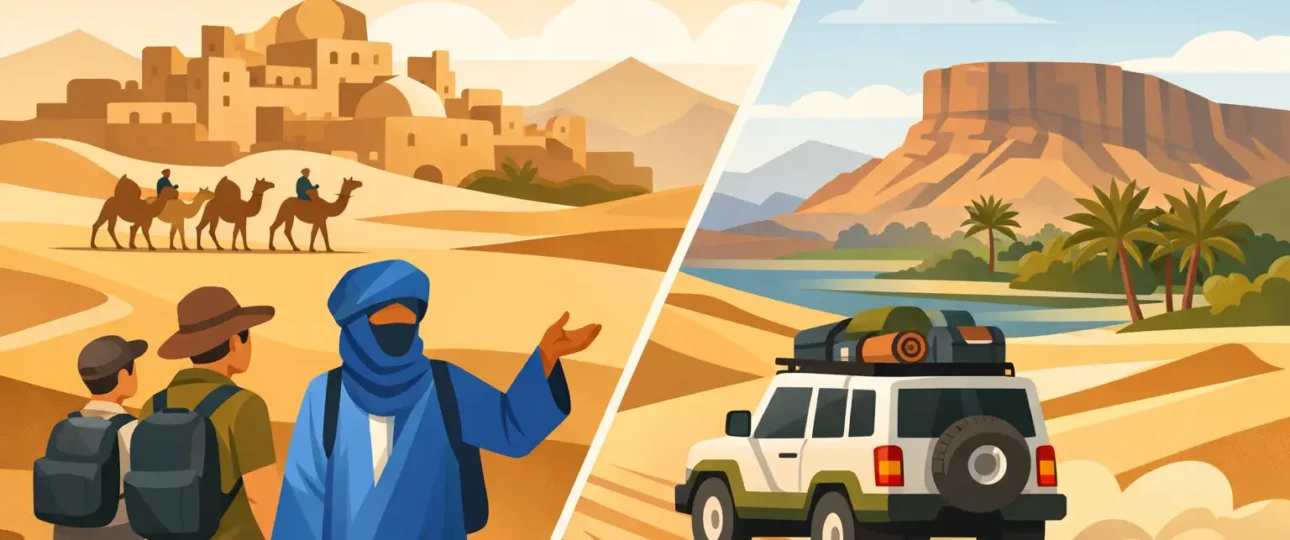
A guided tour gives you structure, local knowledge, and support on the ground. Your route is planned, your transport is handled, permits are arranged where needed, and your nights are set in places that have already been checked for cleanliness, welcome, and security. You spend your energy on the experience itself.
A self-drive trip gives you autonomy. You choose your pace, make your own stops, and keep the schedule flexible. For some experienced overland travelers, that freedom is the point. But in Mauritania, freedom comes with a longer list of responsibilities than many visitors expect.
Road conditions, route finding, police checkpoints, desert driving, fuel planning, communications, and accommodation quality are not side details here. They are central parts of the trip. If you enjoy solving those pieces in real time, self-drive can be deeply satisfying. If you would rather focus on the country than manage the mechanics, a guided journey is usually the better fit.
Safety is not just about driving skill
Many travelers assume self-drive is mainly a question of confidence behind the wheel. In Mauritania, that is only one part of it.
Long distances, remote stretches, soft sand, changing road surfaces, and sparse services can turn a minor mistake into a serious delay. Even on routes that are straightforward in good conditions, local knowledge matters. Which fuel stop is reliable? Which route is realistic in the time you have? Where is it sensible to arrive before dark? Which section is simple in a 4×4 and which one becomes a problem after wind or poor visibility?
A guided trip reduces those risks because the people leading it already know the terrain and the rhythm of travel here. They know how to pace a day so that it remains adventurous without becoming needlessly hard. They also know how to respond when something shifts – weather, access, road conditions, or a change in local logistics.
That is often the hidden value of a guided trip in Mauritania. It is not just that someone drives. It is that someone is actively managing the journey.
Logistics can shape the whole experience
Mauritania is memorable partly because it still feels remote. The same quality that makes it special can make independent travel more demanding.
A self-drive itinerary means arranging the vehicle, understanding what level of 4×4 capability you need, planning fuel and water, preparing navigation, and checking what is required for access on specific routes. You may also need help with airport transfers, accommodation sequencing, and border or visa-related details depending on how you enter the country and how long you stay.
Then there is the day-to-day practical side. Checkpoints are normal. Language can be a barrier in some situations. If you are heading into the desert or combining several regions, timing matters more than many first-time visitors realize.
With a guided trip, those pieces are handled in advance. That is a major reason many travelers choose a local operator. We handle bookings, transport and permits so you do not have to, which means fewer moving parts and fewer chances for avoidable friction once the trip begins.
Cost: self-drive is not always the cheaper option
Self-drive sounds less expensive at first. Sometimes it is. But the real cost depends on the kind of trip you want.
If you want a basic overland journey with a rented vehicle, simple stays, and a flexible route, self-drive may save money, especially if you are sharing costs across a small group. But Mauritania is not a place where every corner of the trip becomes cheaper just because you are traveling independently. Vehicle quality matters. Recovery gear matters. Fuel adds up quickly on long routes. A wrong turn, a timing issue, or a poor accommodation choice can also create extra expense.
Guided tours usually look more expensive because the planning, transport, support, and local knowledge are included from the start. That said, a well-built guided itinerary often gives you clearer value than travelers expect. You know what is covered, your route is realistic, and you avoid spending part of the trip solving problems that a local team could have anticipated.
For many visitors, the question is not whether self-drive has a lower starting cost. It is whether the savings are worth the added uncertainty.
Comfort and energy matter more than people admit
There is a version of adventure travel where every complication becomes a badge of honor. Mauritania tends to reward a more honest approach.
If you are dreaming of crossing dunes, sleeping under stars, visiting ancient caravan towns, and waking early for photography, your energy matters. Long desert days are very different when you are also the person navigating, negotiating logistics, checking in, and troubleshooting the vehicle.
Guided travel does not remove the adventure. It removes the admin around the adventure. That can be the difference between arriving in Chinguetti excited to explore and arriving there tired, late, and preoccupied.
Comfort in Mauritania does not mean luxury in the usual sense. It means secure transport, clean and welcoming guesthouses, practical camp setups, a sensible pace, and support when needed. For a lot of travelers, especially first-time visitors, that creates a stronger trip, not a softer one.
Who should seriously consider self-drive?
Self-drive makes the most sense for travelers who already have experience in remote destinations and are comfortable managing uncertainty without much outside support. If you have driven in desert or low-infrastructure environments before, understand route planning and vehicle limitations, and genuinely enjoy the operational side of travel, Mauritania can be rewarding on your own terms.
It can also suit people with highly specific goals, such as long-form filming, overland transit, or niche route preferences that fall outside a standard itinerary. In those cases, independence can be useful.
But even experienced travelers often underestimate how much local coordination improves the trip here. A common middle ground is to arrange support selectively – car rental, permits, transfers, or part-guided segments – rather than doing everything alone.
Who gets more from a guided trip?
If this is your first visit to Mauritania, a guided trip is usually the stronger choice. The same is true if your time is limited, if you want to cover several major highlights efficiently, or if you are traveling for culture, photography, or a signature experience such as the Iron Ore Train and want the trip to run smoothly.
Guided travel is also a smart option for couples, small groups, and solo travelers who want the confidence of in-country support without having to lower their ambitions. You can still have real adventure – desert crossings, remote camps, historic ksour, coastal wildlife, long road days – while knowing the details are being handled by people who do this regularly.
That is especially valuable in a destination where reliability is not an extra. It is part of what makes the journey possible.
The better question: what do you want to remember?
When travelers compare guided tour vs self drive Mauritania, they often start with control. But the better place to start is memory.
Do you want to remember the satisfaction of building and executing the route yourself, including the hard parts? Or do you want to remember the country more vividly than the logistics – the silence of the desert at dawn, tea shared in a historic town, the scale of the Adrar, the rhythm of the road, and the comfort of knowing someone local is keeping the trip on track?
Neither answer is wrong. Mauritania can reward both styles. But it is not a destination where the trade-offs are minor.
For most international travelers, guided travel offers the best balance of adventure, safety, comfort, and access. It keeps the experience bold while removing much of the friction that can drain time and attention. And if you want that kind of trip, working with a dependable local partner such as Tours in Mauritania often makes the country feel not easier in a superficial way, but more open, more welcoming, and far more enjoyable.
The best Mauritania trip is not the one that proves the most. It is the one that lets you be fully present once the desert opens up around you.